
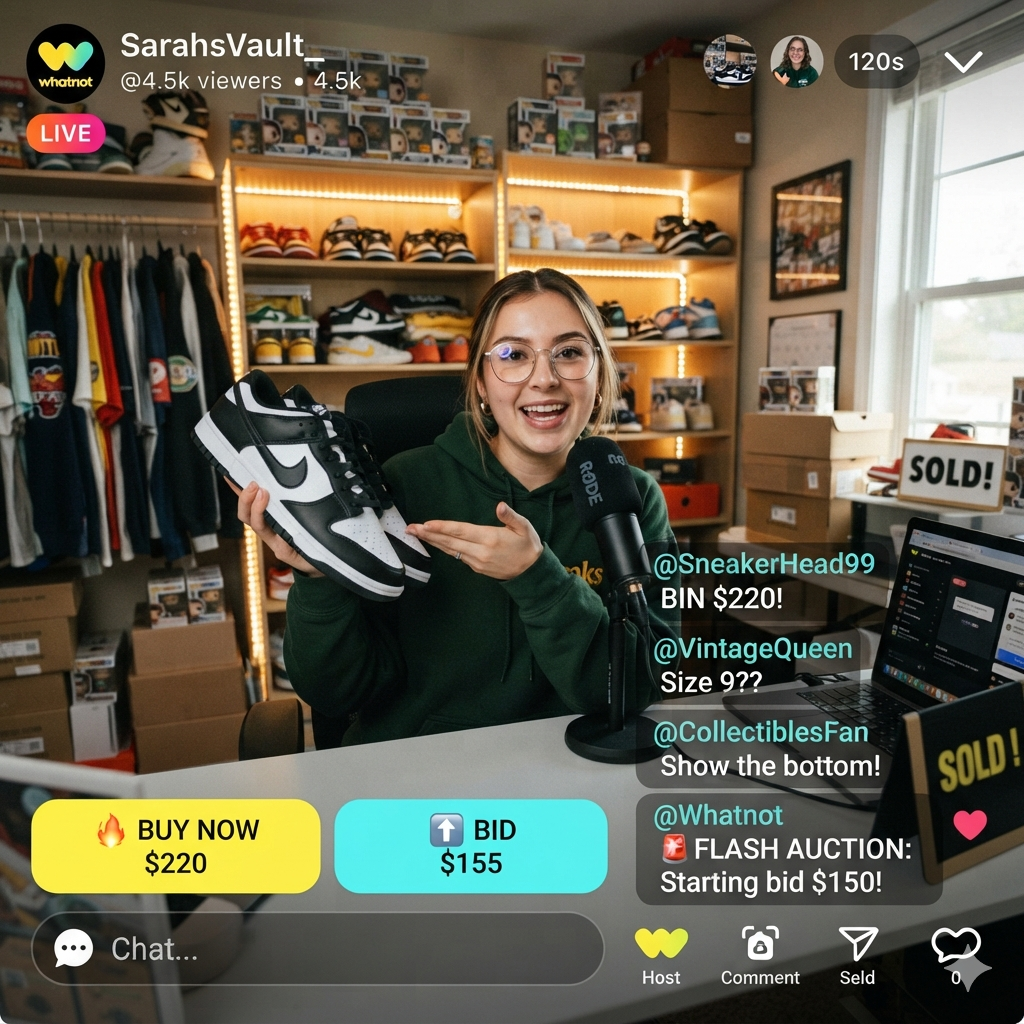
Live selling doesn't cost much money. It costs a lot of hours. So the real question is whether your stock does something in a live room that it can't do in a listing, and whether that's worth your evenings.
The market size isn't your problem
Most live shopping articles open with a big number. That's the wrong place to start if you're a seller, because live selling doesn't really ask you for money. The starter kit is under $100 and you already own the inventory. What it asks for is time, and quite a lot of it.
So the question isn't whether the channel is big enough. It's whether your product does something in a live room that a photo and a description can't do, and whether that's worth giving up your Tuesday nights for. That question has a proper answer, and it depends far more on what you sell than on who you are.
Work through the test below first. If your stock doesn't pass it, you can stop reading and go do something more useful with your afternoon. That's a perfectly good outcome, and a much cheaper one than working it out after ten shows.
The test: which engine does your inventory run on?
Live selling only works when the format adds something a listing can't. There are two ways that happens, and your stock either fits one of them or it doesn't.
| Engine one: passion and scarcity | Engine two: demonstration and impulse | |
|---|---|---|
| What live adds | A clock, a reveal, and a crowd bidding against each other | Proof the product does what it says, with questions answered on the spot |
| Inventory shape | One of one, graded, vintage, deadstock, unpredictable | Repeatable, restockable, cheap enough to buy on a whim, bought again |
| Typical categories | Trading cards, coins and bullion, sneakers, collectibles, luxury resale, memorabilia | Beauty, personal care, apparel, gadgets, food and drink |
| Your job on camera | Prove it's real, then make the ending exciting | Show the change, deal with the objection, close |
| Where it lives | Whatnot, eBay Live | TikTok Shop LIVE, Amazon Live |
Take your best selling SKU and hold it against both columns. If it doesn't fit either one, and plenty of good businesses don't, then live selling won't fix that. Commodity goods on thin margin with nothing to demonstrate and no scarcity behind them will sell exactly as well in a listing as they will on camera, and the listing doesn't need you to be there. Better lighting won't change it. Most people who quit after six weeks had inventory that failed this test and assumed the problem was their setup.
If your stock does land in one of the columns, everything below is about doing that column properly.
Where your answer sends you
Pick your platform based on your engine, not on which one is biggest. Taking collectibles to a beauty crowd is the most expensive mistake available to a new live seller, because you'll walk away thinking the whole format doesn't work.
Engine one: Whatnot first, eBay Live if you're already there
Whatnot is the one place where live selling is the entire business rather than a bolt on, and you can see it in how people behave. Buyers spend roughly 80 to 95 minutes a day in the app, more than 80% come back month after month, and there are over 500,000 hours of live shows streamed weekly. The platform did more than $8 billion in live GMV in 2025, more than double the year before, crossed $1 billion in revenue, and was the number one shopping app in both the US and UK. Standard commission is 8%, dropping to 4 to 6% in some collectible categories, and 0% on the portion of any order above $1,500 in select categories.
The number that should interest you most isn't the GMV though. It's that more than half of surveyed Whatnot sellers now say the majority of their annual sales come through live commerce, and the count of sellers making at least $10,000 a month has more than doubled year on year. This stopped being a side hustle platform a while ago.
eBay Live is the obvious first move if you already sell on eBay, because your feedback, your listings and your existing buyers all come with you. No new Whatnot seller gets that, and it's the single biggest head start available anywhere in live commerce. eBay said its live GMV run rate was up roughly fivefold year on year on the Q3 2025 earnings call, with viewers, watch time and items sold all growing. Around 57.3 million of eBay's roughly 135 million active buyers have engaged with the feature, though eBay hasn't broken out how many actually buy versus just watch. Categories have expanded well past the original collectibles and luxury beta into sneakers, apparel, sporting goods, home and garden, health and beauty, and electronics. Access is still gated, so register your interest early. That approval queue, not your equipment, is what sets your real start date.
Engine two: TikTok Shop LIVE, with your eyes open
TikTok Shop LIVE converts better than anything else on the platform. Benchmarks put live at around 7.8% against 2.1% for feed ads. But look at the trend before you commit your hours to it. TikTok Shop's US business grew 103% year on year to $11.8 billion in the first half of 2026, while live selling dropped to 8.2% of that, down from 14% for full year 2025. Live isn't shrinking in dollar terms, it grew about 19% from roughly $812 million to $967 million. The Shop tab just grew about three times faster and now takes 51.4% of attributed GMV, up from 36%.
In practice that means TikTok is turning into a storefront and short video business with live attached, rather than a live first platform. If you're in beauty or consumables it's still the right room, but budget for short video alongside the streaming instead of treating live as the whole plan.
Amazon Live is the cheapest test going. It's free for sellers and Amazon Influencers, your streams show up on your own product pages and in the Live feed, and there's no fee beyond standard Amazon selling fees. It suits established Amazon brands adding video proof to demand that already exists, rather than anyone trying to build an audience from scratch.
Owned site tools like Bambuser, Firework, Channelize, Sprii, LiveMeUp and Videeo put live shopping on your own Shopify or BigCommerce store. Only worth it if you already have traffic and a decent email list. The software handles the video and the checkout. Getting anyone to turn up is entirely on you.
| Platform | Brings you demand? | Fee | Best fit |
|---|---|---|---|
| Whatnot | Yes, the biggest live native audience | 8% standard, 4 to 6% some collectibles, 0% above $1,500 in select categories | Cards, coins, sneakers, collectibles, streetwear, women's fashion, beauty |
| eBay Live | Yes, plus your existing eBay reputation | Standard eBay final value fees | Existing eBay sellers in collectibles, luxury, sneakers, apparel, electronics |
| TikTok Shop LIVE | Yes, but algorithmic rather than loyal | Around 6% commission plus fees | Beauty, personal care, apparel, impulse consumables, high volume and low AOV |
| Amazon Live | Partly, via placement on your own listings | No extra platform fee | Established Amazon brands adding video proof to demand they already have |
| Owned site tools | No, you bring the audience | SaaS subscription | DTC brands with an existing list and repeat customers |
The categories actually compounding right now
Whatnot's data gives the clearest read on momentum, since it's the platform where live is the whole business. Two things are happening at the same time. Collectibles still carry the volume, and the fastest growth has moved into lifestyle categories as the platform's female shopper base more than doubled.
| Category | Engine | Growth signal | Why it works live |
|---|---|---|---|
| Beauty and personal care | Two | Up nearly 800% year on year on Whatnot, around 22% of US TikTok Shop GMV | Before and after works on camera, cheap enough to try, bought again |
| Consumer electronics | Two | Up around 444% | Spec questions get answered faster than in a listing, good for showing refurb condition |
| Jewellery | Both | Up around 259% | Scale and sparkle are hard to photograph, live close ups sell it |
| Women's fashion | Two | Up around 223%, with more than 12 million monthly fashion orders on Whatnot | Fit and drape shown on a body, and extended sizing is a stated growth pocket |
| Trading cards and memorabilia | One | Still the biggest categories by volume. WNBA searches up 1,670% in 2025, three times the pace of NBA cards | The break format was made for live: scarcity, a reveal, a community, and a reason to come back |
| Coins, bullion and precious metals | One | The quiet giant, with sellers averaging over $1,000 per show. Goldback up 545% | High order values, authentication matters, buyers want to see it handled |
| Sneakers and streetwear | One | Consistently top tier across Whatnot, eBay Live and TikTok | Drop mechanics, legit check culture, and a natural fit with auctions |
| Food and drink | Two | Flagged by Whatnot's CEO as a 2026 push, and called out as a high growth TikTok Shop vertical | The open opportunity, as live moves past the classic demo categories |
If your category is on that list you've got a tailwind and company. If it isn't but it passes the engine test, you might have an opening. The categories nobody is streaming yet are where the next round of 800% growth numbers is going to come from.
Is the room big enough to bother with?
Worth being straight about the market size, because you'll see wildly different figures quoted at you. eMarketer's January 2026 forecast put US livestream commerce at $14.64 billion for 2025, up close to 50% year on year, with the buyer base growing about 21.5%. Whatnot's own report sizes the North America and Europe market at roughly $22 billion, though that's a market leader sizing the market it leads. Coresight's older and much repeated forecast of around $68 billion for 2026 hasn't happened. Live sits near 5% of US ecommerce, against roughly 60% in China.
The useful bit for a seller isn't that the market is smaller than the headlines promised. It's that it's concentrated. Whatnot claims close to 60% of the North America and Europe market. On TikTok Shop, live's share is falling even while the platform booms. More than 90 million US adults have now tried livestream shopping, with buyer share up from about 25% in 2024 to 34% in 2026, so trial is mainstream but the habit is still forming.
Concentration is good news if you're willing to choose. It means the market average understates what a well placed seller can do, and it means spreading yourself across every platform is how you waste a quarter. Pick the room your engine points at and put all your hours there.
Steps to success: getting on camera
From here on this assumes you passed the engine test, you already sell on a marketplace, you've got inventory on hand and you know your numbers. That puts you well ahead of most people starting out. What you're missing is a format and the nerve.
Step 1: Commit to one platform, and watch before you stream
Your engine picked your platform. Apply now, since approval queues on eBay Live are real. Then spend a week watching. Sit in ten shows in your exact category and pay attention to pacing, price points, how the host handles a dead room, and what they do in the first ninety seconds. It's the cheapest research you'll ever do and it's the difference between a first show that feels improvised and one that feels like a format.
Anyone who splits across three platforms in month one does all three badly. One platform, one schedule, ten shows.
Step 2: Do the maths before the first show
Live has costs a listing doesn't: your hours, giveaways, combined shipping discounts and commission. Model a two hour show at 8% (Whatnot) or around 6% plus fees (TikTok), assume you'll hand back 2 to 5% of GMV in freebies and bundle discounts, and price from there.
Track GMV per streaming hour rather than per show, because your constraint is camera time, not the calendar. Set yourself a floor before you start. If a two hour show can't clear a number you'd accept for two hours of your own labour after fees, then your price points or your inventory are wrong for the format, and it's much better to find that out in week two than in month three.
Step 3: Count the hours honestly
This is where most people underestimate live selling. The stream is the visible part, but it's maybe a third of the work. A single weekly show looks roughly like this once you're running properly.
| What | Hours per weekly show | Notes |
|---|---|---|
| Sourcing and pulling stock | 2 to 4 | You need 30 to 50 items a show. Every week. This is the load nobody budgets for. |
| Pricing, lotting and prep | 2 to 3 | Photographing, grading, setting starting bids, ordering the run sheet |
| The show itself | 2 | Plus 30 minutes either side for setup and teardown |
| Packing and shipping | 3 to 5 | The hidden one. Dozens of small orders, combined bundles, labels, drop off, all inside 48 hours |
| Promo and community | 1 to 2 | Announcing the next show, answering messages, replying to buyers |
| Total | 10 to 16 | For one show a week |
Scale that up and you get to where the serious sellers live. People running live as their main channel on TikTok Shop are streaming 15 to 25 hours a week, which with everything around it is a full time job and then some.
A few things follow from that table. Ten to sixteen hours a week has to come from somewhere, so decide now what you're going to stop doing. If you're already at capacity on your marketplace listings, live isn't an addition, it's a swap. Packing is the piece that ambushes people, because a good show can leave you with fifty small orders that all need to go out in two days, and that's a Sunday gone. And the ramp is a quarter rather than a month: the 30 day plan further down gets you started, but the audience compounding that makes the numbers work takes a few months of showing up in the same slot.
Space matters too, though less than people think. A corner of a room with a table, a clean background and somewhere to stack sold items is enough. What you actually need is somewhere you can leave set up, because if you have to rebuild the whole thing every week you'll skip shows.
Step 4: Buy the minimum kit, in this order
Don't build a studio. Whatnot's own production guidance is blunt about the priority: lighting affects how your camera looks more than anything else, and a two point setup beats a ring light because it balances shadows and cuts glare instead of flattening everything.
| Tier | Kit | Rough spend (USD) |
|---|---|---|
| Show one | A phone from the last three or four years, a stable tripod with a wireless remote, one ring light or a good window, wired earbuds with a mic, solid internet, a plain backdrop, and a second device for chat | $50 to $100 |
| After about ten shows | Two point lighting kit with a key and fill, a lav mic if you move around, an overhead or side arm mount for tabletop categories, and a labelled bin system | $150 to $400 |
| Scaling | Mirrorless camera or webcam into OBS, multi cam for close ups, 60 to 100W panels, a dedicated moderator, and on screen promo graphics | $800 and up |
Two things people skip that they shouldn't. A second screen for chat, because reading comments on the phone you're broadcasting from makes you look distracted. And a labelled bin system so every sold item goes into its slot during the show. Sorting afterwards is where sellers lose their evenings and their shipping ratings.
Test everything on a private practice stream before you go public. Not testing the setup first is the most common preventable mistake there is.
Step 5: Build a show format you can repeat
A show is a product. It needs a shape people can learn. Aim for 30 to 50 items on a first show so the pace never stalls.
Format moves conversion more than most sellers expect. TikTok benchmark data has flash sales with limited stock converting at around 11.2%, product demos with Q and A around 8.4%, and pure entertainment streams down near 4.1%. Length matters too. Conversion peaks in the 30 to 60 minute window, shorter 15 to 30 minute sessions protect your average order value, and very long sessions get you more orders at a lower average.
- First 5 minutes: open with your best item visible, not with an introduction. Say what's coming and give people one reason to stay to the end.
- 5 to 15 minutes: mid tier items at a brisk pace to get some transactions on the board. Early activity compounds, and Whatnot has reported that shows with strong pre bid activity can generate up to seven times more total sales.
- 15 to 45 minutes: your core inventory. Alternate a hero item with three or four quick ones so the pace never flatlines.
- Last 10 minutes: the item you teased at the open. Then tell them the exact day and time of your next show.
Run the same slot every week. Repeat viewership is the whole economics of live selling, and that needs a time people can remember without being told twice.
Step 6: Presentation skills that actually shift product
You're not performing. You're doing what a good market stall trader does, which is describing an object to someone who already wants to buy it.
- Talk to the item, not the camera. The classic beginner failure is staring down the lens with nothing to do with your hands. Hold the product, turn it, point at the flaw. Your energy follows your hands.
- Name the defect first. Say the scuff, the missing tag, the reprint. Volunteering the flaw is the fastest way to build trust in live selling and it stops the return before it happens.
- One sentence per attribute. What it is, what condition, what it's worth, what you're asking. Then stop talking. The silence is what lets the bid land.
- Be specific. "1998, sealed, from a smoke free collection" beats "really nice piece". Buyers can tell within seconds whether you know your product, and that knowledge is your real advantage over a better lit competitor.
- Manage your voice, not your face. Pace and volume carry live audio. Slightly slower and slightly louder than feels natural is usually about right.
- Have something for the dead patches. When nothing sells for three minutes, default to a story about how you sourced the item, or a quick poll. Dead air is what people leave on.
Step 7: Get the room involved on purpose
The advantage live has over a listing is that people are in a room together. Everything below is there to make that feel true.
- Use names constantly. Greet everyone who arrives by username, announce every purchase by username. This is the thing that turns viewers into regulars, and it costs nothing.
- Answer questions out loud before you answer them in chat. One person asked, forty are wondering.
- Give people a job. Polls, open it or leave it sealed, votes on what comes next. Participation comes before purchase.
- Keep scarcity honest. One of one items, a real countdown, genuinely limited stock. Made up urgency gets found out fast in a chat room with a memory.
- Reward people for staying. A giveaway at a set time, free shipping on multi buys, a discount for returning buyers. Combined shipping discounts work hard here, since someone who's already bought once will buy again to reach the bundle.
- Get a moderator early. Even a friend. Someone answering shipping questions in chat while you sell roughly doubles what you can get through.
- Ship fast and say so. Fast shipping drives reviews, reviews drive visibility, visibility fills your next show. Top sellers ship in 24 to 48 hours whatever the stated window says.
Step 8: Getting past the fear of being on camera
This is the actual barrier, not the equipment. Worth saying plainly: eBay is piloting host matching and streaming as a service partners precisely because a lot of capable sellers with great inventory don't want to be on camera. You're not unusual. But it's a beatable problem, and you beat it mechanically rather than by waiting until you feel ready.
- Work out what you're actually afraid of. It's nearly always being watched while failing, in public, with no edit. Which means the fix is shrinking the audience, not summoning up confidence.
- Stream to nobody first. Three private practice streams with the app recording. No audience, no stakes. Watch each one back once, just once, don't spiral on it. By the third you'll have solved most of what was worrying you.
- Put your first show at a bad time on purpose. Tuesday morning. You want a small audience. A first show with eleven viewers is a rehearsal that happens to make some sales.
- Script the first ten minutes and nothing else. Nerves peak at the open. Write your first three sentences and first three items word for word. After that you're just talking about products you know.
- Remember who's watching. People in a live shopping stream are there because they like the category. They're the friendliest audience in retail and they're not judging you, they're waiting for the next item.
- Set a show count, not a revenue target. Commit to ten shows before you judge anything. It takes the weight off any single stream, and it matches how the format works, since the audience builds across sessions.
- Accept that the first few are awkward. Everyone's first five are stiff. The sellers clearing $10,000 a month now all have bad early streams behind them. The only difference is they kept turning up.
- If it's still a hard no, hire the face. Co host, a host matching pilot, or a creator partnership. Your sourcing and product knowledge is the scarce thing here. Being on camera is a skill you can rent.
Step 9: Measure the right things
| Metric | Why it matters | What to do with it |
|---|---|---|
| GMV per streaming hour | Your real unit of production | If it isn't rising by show ten, change the format or the category, not the effort |
| Average watch time | Predicts conversion better than viewer count does | Find where people drop off and fix that section's pacing |
| Returning buyer rate | The whole business model. Whatnot reports over 80% month on month retention platform wide | If regulars aren't forming, your schedule or your community habits are the problem |
| Sell through per show | Tells you whether you're bringing the right stock | Below about 50%, your price points are above your room |
| Margin after fees, giveaways and shipping | Live's costs hide in the extras | Track it per show, not per month, or you'll find out too late |
A 30 day start plan
This gets you going. It doesn't get you to a business, since that takes a quarter or so of consistent shows.
| Week | Do this |
|---|---|
| 1 | Run the engine test on your top SKUs. Apply to your platform. Watch ten shows in your category. Work out where 10 to 16 hours a week is coming from. |
| 2 | Buy the starter kit. Set up a space you can leave standing, and build your bin system. Three private practice streams. Pull and price 30 to 50 items. |
| 3 | First public show, deliberately off peak. Second show three days later in the slot you intend to keep. Ship everything within 48 hours. |
| 4 | Two more shows, same slot. Look at GMV per hour and where watch time drops. Change one variable, whether that's format, pacing or price. Not three. |
So, is it time?
Live selling rewards two things most marketplace sellers already have, which are product knowledge and inventory depth. It demands one thing most of us don't have spare, which is ten to sixteen hours a week on a fixed schedule, most of it off camera.
If your stock runs on passion and scarcity, or on demonstration and impulse, then the concentration in this market works in your favour. Pick the room your engine points at, commit ten shows to one weekly slot, decide what you're dropping to make the hours, and judge it on GMV per streaming hour rather than on any one night. If your stock runs on neither, spend the ring light money on better listing photos and get on with your day.
Sources: Whatnot State of Live Selling Report 2026 and 2026 Consumer Trends Report; Whatnot Seller Academy production guidance; Momentum Works and Tabcut H1 2026 TikTok Shop analysis; Dashboardly TikTok LIVE benchmarks (April 2026); eBay Q3 2025 earnings call, Seller Center and eBay Live seller webinars; eMarketer US livestream commerce forecast (January 2026); Coresight Research; McKinsey.