
Article Summary: Key Insights at a Glance
- The 2026 memory crisis has changed the economics of this category completely. Gartner projects a 130% surge in combined DRAM and SSD pricing by the end of 2026, pushing PC prices up 17% year over year and driving global PC shipments down 10.4%. Every dollar of that increase pushes buyers toward repair, upgrade and refurbishment instead of replacement.
- Sellers should not try to manufacture modular laptops. The winning position is the accessory, parts and upgrade ecosystem that surrounds them, where MOQs are low, tooling costs are modest and margins run 45% to 68%.
- The single loudest complaint in the modular laptop community is not price or performance. It is spare part availability. Owners of the most repairable laptop on the market report waiting months for out-of-stock components, which is a direct inventory arbitrage opportunity for third-party sellers.
- Expansion card ecosystems, mainboard reuse enclosures, storage and memory upgrade kits, and precision repair toolkits are the four highest-scoring product segments, with opportunity scores of 8 to 9 across Amazon, Shopify DTC and specialist channels.
- The EU Right to Repair Directive applies from 31 July 2026, and laptops sit in the Ecodesign for Sustainable Products Regulation work plan for future inclusion. Manufacturers already face seven to ten year spare part obligations in adjacent categories, which expands the addressable aftermarket permanently.
- Open source CAD files for major modular laptop chassis are publicly available, which removes the reverse-engineering barrier that normally protects OEM accessory revenue. Sellers can design fitted cases, skins, bezels, port covers and stands from official geometry.
- The buyer is not a mainstream consumer. Seven distinct personas dominate, and five of them are technical, price-insensitive at the accessory tier, and heavily concentrated in Linux, homelab, developer, IT asset disposition and sustainability communities.
- Best entry point for a new seller: a precision modular laptop repair and upgrade toolkit at the $34 to $49 retail band, landed at roughly $9.80 per unit, with a startup cost under $4,900 and blended margins near 61%.
- Avoid three traps: cloned mainboards and batteries with counterfeit cell certifications, anything requiring firmware or software pairing, and generic laptop parts repackaged as modular-compatible without verified fitment.
- The seasonal peak is not Q4. Demand clusters in late August through September (student and homelab build season) and again in January through February (post-CES upgrade cycle and new mainboard releases).
1. Executive Opportunity Summary
Top 3 Selling Opportunities Right Now
Opportunity 1: Expansion Card and Port Module Accessories
Opportunity Score: 9/10
Product segment plus marketplace combination: Third-party expansion cards, card storage carriers, port dust covers and multi-card travel organizers, sold on Amazon US, Shopify DTC and Etsy.
The modular laptop port system is the most visible and most frequently swapped element of the entire category. Owners buy multiple sets, lose them in bags, and replace them when travel needs change. Original manufacturer stock is periodically constrained, and secondhand single cards trade actively on eBay at prices close to new retail, which is a reliable signal of demand outstripping supply.
Profit margin range: 58% to 68% on accessory-class items (carriers, covers, organizers), 41% to 52% on functional cards with active electronics.
Growth signal: Community-developed modules and open source card designs have expanded steadily since the manufacturer opened its ecosystem to third-party listings, and the installed base of modular laptops has grown every year since 2021.
Opportunity 2: Mainboard Reuse Enclosures and Second-Life Kits
Opportunity Score: 9/10
Product segment plus marketplace combination: Enclosures, cooling shrouds, power adapters and mounting kits that convert a retired modular laptop mainboard into a standalone mini PC, sold on Shopify DTC, Amazon and Tindie-style maker channels.
This is the sharpest product-market fit in the category. When an owner upgrades their mainboard to a newer CPU generation, they are left holding a fully functional computer with no case. The manufacturer sells a first-party enclosure, but supply and colour options are limited and community 3D printed alternatives are widespread, which proves demand exists well beyond what is being served.
Profit margin range: 52% to 64%.
Growth signal: Every mainboard upgrade cycle creates a new unit of demand. As the installed base compounds and CPU generations refresh annually, this segment grows structurally rather than cyclically.
Opportunity 3: Memory and Storage Upgrade Kits Bundled for Modular Chassis
Opportunity Score: 8/10
Product segment plus marketplace combination: Pre-validated SO-DIMM DDR5 and M.2 2280 or 2230 storage kits, packaged with the correct standoffs, thermal pads and a fitment guide, sold on Amazon, Newegg Marketplace and Shopify DTC.
Modular laptops use standard SO-DIMM DDR5 slots rather than soldered memory, which is precisely the configuration that has become valuable in a shortage. Buyers who cannot afford a new machine at 2026 pricing can extend an existing one for a fraction of the cost. The catch is that memory itself is the constrained commodity, so margin discipline and inventory timing matter more here than in any other segment.
Profit margin range: 22% to 34% on the memory itself, 48% to 60% on the kit packaging, thermal accessories and fitment components.
Growth signal: TrendForce data shows memory components have grown from roughly 15% of a laptop bill of materials to more than 30% across several quarters of increases, which makes the upgrade path economically compelling relative to replacement.
Quick Action Items
- Source expansion card carriers and port covers from Shenzhen injection moulding suppliers within 30 days. Tooling for a simple ABS or polycarbonate carrier runs $800 to $1,900 and amortises across 3,000 units. Request PC-ABS blend rather than straight ABS for dimensional stability against the aluminium chassis tolerance.
- Download the publicly released open source chassis CAD before designing anything. The external 3D CAD of the 16-inch modular platform and its main modules is published on GitHub specifically to enable third-party cases, skins and replacement parts. Designing from official geometry eliminates the tolerance guesswork that kills first production runs in fitted-accessory categories.
- Buy memory forward, not just in time. Contract DRAM pricing rose sharply from late 2025 and analysts describe the situation as structural rather than cyclical, with elevated pricing projected into 2027 and beyond. Any SO-DIMM inventory secured in the current quarter is a hedge against Q4 2026 pricing, which is where the peak is currently expected.
- Build the listing around fitment certainty, not features. The dominant buyer anxiety in this category is whether a part actually fits their specific generation. Model-and-generation compatibility tables in the A+ content, plus a QR-linked fitment checker, convert better in this niche than any lifestyle photography.
- Open a Shopify DTC storefront alongside the Amazon listing from day one. This audience actively prefers buying direct from small operators, distrusts marketplace-generic branding, and is reachable through Linux, homelab and right-to-repair communities where Amazon-only sellers have no credibility.
Red Flags to Avoid
Red Flag 1: Replacement batteries and mainboards from unverified factories. Lithium cell certification fraud is common in the laptop parts trade. A battery with a forged UN38.3 test summary or a counterfeit IEC 62133 certificate is a product liability event, an Amazon account suspension, and a shipping compliance failure all at once. If you cannot obtain the cell manufacturer's own certificate rather than the pack assembler's, do not buy.
Red Flag 2: Anything gated by firmware or software pairing. Parts pairing remains an active constraint even as hardware modularity improves across the industry. A component that is mechanically compatible but software-rejected produces a 100% return rate. Test on current firmware, and re-test after every vendor BIOS release before committing to a second production run.
Red Flag 3: Generic laptop parts relabelled as modular-compatible. Screens, keyboards and hinges sourced from broad-market laptop parts suppliers rarely match the specific mounting geometry of modular chassis. Listings that overpromise fitment in this community are dismantled publicly on forums within days, and the reputational damage carries across every channel you sell on.
Best Entry Point for New Sellers
Product recommendation: A precision repair and upgrade toolkit purpose-built for modular laptops. Contents: a 60-bit driver set with T5 Torx and PH0 as the anchor bits, an anti-static nylon spudger set, an ESD wrist strap, a magnetic parts mat printed with a chassis-specific screw map, SO-DIMM and M.2 thermal pads, spare standoff screws, and a nylon opening pick set.
Primary marketplace: Amazon US. Secondary marketplace: Shopify DTC storefront with community-channel distribution.
Price range: $34 to $49 retail, with the $39 price point as the volume sweet spot.
Detailed startup cost breakdown:
- Factory unit cost at 500 MOQ: $9.80 per unit ($4,900)
- Custom printed magnetic mat with screw map (tooling and plate setup): $340 one time
- Retail packaging design and die line: $420 one time
- Packaging production at 500 units: $0.62 per unit ($310)
- Sea freight LCL, Shenzhen to Los Angeles, 0.9 CBM: $410
- Customs duty and merchandise processing fee: approximately $290
- Amazon FBA inbound shipping and prep: $265
- UPC codes, brand registry, trademark filing: $410
- Product photography and A+ content: $650
- Initial PPC budget (first 60 days): $900
- Compliance and sample rounds (two samples): $180 Total startup cost: approximately $9,075 for 500 units, of which $4,900 is recoverable inventory.
Why this works: The toolkit sidesteps every structural risk in the category. There is no lithium cell, no firmware pairing, no fitment liability on a load-bearing component, and no dependency on constrained memory supply. It is a low-return-rate product with a naturally high perceived value, it is a gateway purchase that pulls buyers into your other listings, and it is the one item every single modular laptop owner needs regardless of which model or generation they own. The screw map on the mat is the differentiator that turns a commodity driver kit into a category-specific product with defensible branding.
2. Quick Data Scans: Marketplace Sales Opportunity Analysis
Opportunity Score Legend
Opportunity Score traffic light ranges:
- 8-10: High demand, low to moderate competition (ENTER NOW) - Green
- 5-7: Moderate demand, moderate competition (TEST CAREFULLY) - Yellow
- 1-4: Low demand or oversaturated (AVOID) - Red
Marketplace Opportunity Score Product Segment Est. Weekly Unit Sales Est. Weekly Revenue Avg Price Range Est. Profit Margin Amazon US 9 Precision repair and upgrade toolkits
T5 Torx anchor, chassis screw map mat310 - 470 $12,400 - $18,800 $34 - $49 55 - 64% 8 Expansion card carriers and organizers
4-slot and 6-slot, PC-ABS180 - 290 $3,600 - $6,100 $18 - $26 58 - 68% 6 SO-DIMM DDR5 upgrade kits
Memory cost exposure is high95 - 160 $14,300 - $25,600 $149 - $189 22 - 34% Shopify DTC 9 Mainboard second-life enclosures
Aluminium or PC-ABS, VESA mount option70 - 120 $5,600 - $10,800 $79 - $109 52 - 64% 8 Custom colour bezels and skin sets
Colours the OEM does not offer85 - 150 $3,000 - $5,600 $32 - $44 60 - 71% 7 Fitted sleeves and modular travel cases
Card pockets, screwdriver loop60 - 110 $3,300 - $6,400 $52 - $62 54 - 63% eBay US 8 Used and pulled expansion cards
Arbitrage against OEM stockouts140 - 240 $2,800 - $5,300 $16 - $24 38 - 57% 7 Refurbished mainboards and prior-gen kits
Tested, warranty stated in listing25 - 55 $8,800 - $19,300 $310 - $360 18 - 29% Etsy 8 3D printed mods and one-piece palm rests
Custom colour, low volume, high margin45 - 90 $2,200 - $4,700 $44 - $58 62 - 74% Newegg Marketplace 7 M.2 storage and thermal upgrade kits
2230 and 2280 with pads and standoffs55 - 105 $5,500 - $11,000 $98 - $118 26 - 38% Walmart Marketplace 5 General laptop repair toolkits
Audience skews non-technical90 - 170 $2,300 - $4,400 $24 - $29 31 - 43% TikTok Shop 6 Visual mod kits and colour bezel sets
Teardown and swap content converts70 - 210 $2,400 - $7,600 $29 - $38 44 - 56% Amazon EU (DE, FR, NL) 8 Repair toolkits and carriers
Right to repair tailwind, low listing density130 - 240 $5,200 - $10,300 $36 - $47 48 - 59% Tindie / maker channels 7 Functional custom expansion cards
Niche IO, sensors, storage carriers20 - 55 $1,100 - $3,300 $52 - $64 41 - 52% Instagram / Meta Shopping 5 Aesthetic mod bundles
Discovery only, weak direct conversion25 - 70 $900 - $2,600 $34 - $40 42 - 54% Reverb / specialist B2B refurb 6 Fleet refurb parts bundles for ITAD buyers
10 to 50 unit lots, invoice terms8 - 22 lots $6,400 - $17,600 $780 - $820 per lot 29 - 41% Target Plus 3 Any modular laptop accessory
Audience mismatch, curated onboardingUnder 15 Under $600 $29 - $39 28 - 36% Best Buy Marketplace 4 Repair toolkits
Category exists but traffic is brand-led18 - 40 $700 - $1,600 $38 - $42 30 - 39%
Table Notes and Methodology
Unit and revenue estimates are modelled from a combination of visible marketplace signals rather than a single proprietary data feed. Inputs include marketplace search result density for the relevant keyword clusters, review velocity on existing listings in adjacent accessory categories, sold-listing frequency on eBay for modular laptop components, and observed sell-through on maker channels where inventory counts are publicly visible. Where a segment has few incumbents, the range is widened to reflect estimation uncertainty rather than narrowed to a false precision.
Profit margin figures are net of marketplace referral fees, fulfilment fees where applicable, an allowance for pay-per-click advertising at 9% to 14% of revenue depending on channel, and a returns provision of 3% for non-electronic accessories and 7% for functional electronics. Memory and storage segments carry materially lower margins because the underlying commodity is itself in shortage, and because sellers in those segments compete against manufacturers with far better forward contract positions.
The Amazon EU score reflects an unusual condition: the regulatory environment is actively expanding the repair market at the same time as listing density remains low relative to the US. That gap is unlikely to persist beyond 2027.
Target Plus and Best Buy Marketplace score low not because the products fail there but because the audience does not exist there in meaningful volume. Modular laptop buyers are a self-selecting technical population who shop in specific places, and general retail channels dilute both conversion and margin.
3. Deeper Context: Market Landscape and Buyer Intelligence
A. Market Overview
Category Definition and Size
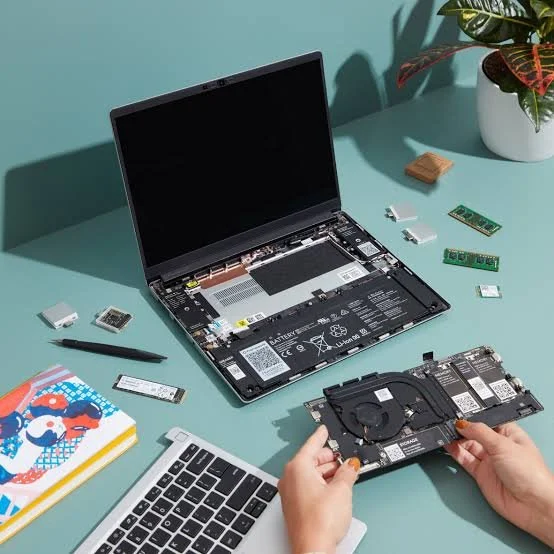
Repairable modular laptops are portable computers designed so that the major subsystems, including battery, memory, storage, display, keyboard, hinge assembly, speakers, cooling, ports and in some cases the entire mainboard, can be removed and replaced by the owner using standard tools and without adhesive removal or specialist equipment. The defining test is not whether a device can be opened but whether first-party replacement parts and documentation are publicly available to anyone who wants to buy them.
The category is small in unit terms and large in influence. The leading dedicated manufacturer has earned a perfect 10 out of 10 repairability score from iFixit, ships a screwdriver in the box, allows the battery, memory, storage and ports to be swapped without special tools or technical skill, and commits to keeping replacement parts available for at least five years after a product is discontinued. That combination has pulled the rest of the industry along behind it. At CES 2026, a major incumbent introduced a modular chassis redesign for its flagship business ultrabook in which the battery, keyboard, speakers, fans and USB-C ports can all be removed and replaced, earning a 9 out of 10 iFixit repairability score. A second manufacturer announced a semi-modular laptop at the same show, drawing directly on the modular design philosophy.
For sellers, the addressable market is not the laptops. It is the accessory, parts, upgrade and second-life ecosystem that sits around an installed base which now compounds annually and, critically, is designed from the outset to accept third-party components.
The macroeconomic backdrop in 2026 is the single most important market condition in this report. Gartner estimates a 130% surge in combined DRAM and solid-state drive prices by the end of 2026, which will increase PC prices by 17% and smartphone prices by 13% compared with 2025 levels, and projects worldwide PC shipments to decline 10.4% in 2026. TrendForce data shows memory components have grown from about 15% of a laptop bill of materials to more than 30% after several quarters of increases. The practical consequence is that repair, upgrade and refurbishment have become the rational economic choice for a large population of buyers who would otherwise have replaced their machines, and the professional refurbished market is seeing significant demand growth as a result.
Product Evolution and Recent Trends
The modular laptop began as an ideological product in 2021 and has become a technically competitive one. The 2026 generation of the flagship 13-inch model moved to a CNC-milled aluminium chassis at 1.4 kg and 15.85 mm thickness with Intel Core Ultra Series 3 processors, a configuration that no longer asks buyers to accept a build quality penalty in exchange for repairability. Batch 8 of that model sold out within a week of announcement, which the review community read as evidence that the audience for a genuinely premium repairable laptop is larger than the broader market assumed.
Four structural trends define the current moment:
Open sourcing of chassis geometry. External 3D CAD of the 16-inch platform and its main modules has been published on GitHub explicitly to enable community development of cases, skins and other customisation parts. CAD design files for custom builds featured again in the 2026 launch event alongside Ubuntu-certified configurations. For a private label seller, this eliminates the reverse engineering cost that normally gates entry into fitted-accessory categories.
Expansion of the modular surface area. The 2026 refresh of the 16-inch model introduced a redesigned one-piece haptic touchpad and keyboard, and an Expansion Bay system allowing users to upgrade discrete graphics and peripherals. Each new modular interface is a new accessory category.
Materials and sustainability as a spec line. The 2026 lineup incorporates a bezel made from 98% post-consumer recycled polycarbonate. Sustainability claims are moving from marketing copy into verifiable component specifications, which raises the bar for third-party parts that want to sit credibly alongside them.
Community modding as a demand generator. Community projects range from a 3D printed brick-compatible expansion card that lets owners attach feet, cable holders and even wheels to their laptop, through open source RGB LED matrix retrofits, to one-piece palm rest replacements sold on craft marketplaces by independent makers. This activity does two things for a seller: it validates demand before you tool up, and it publishes the geometry you need.
Leading Brands and Market Disruptors
The dedicated modular manufacturer holds the definitional position. It operates its own marketplace selling replacement keys, speakers, covers, cables, webcams, display bezels, expansion cards, keyboard decks, heatsinks and fans, bottom covers, batteries, displays, hinges and entire mainboards directly to owners with no questions asked, and it has stated an intention to open marketplace listings to third-party and community-developed modules and to enable resale of new, used and refurbished products.
The incumbent business laptop brands are the fast followers. The 2026 modular chassis redesign from a major ThinkPad-line manufacturer represents the first time a top-three PC vendor has treated user-serviceable modularity as a flagship feature rather than an enterprise concession. A second Taiwanese-linked builder announced a semi-modular design at CES 2026.
The counterweight is the sealed-device camp, where premium ultrabooks continue to ship with soldered memory, glued assemblies and active resistance to independent repair. The commentary framing of 2026 has been a direct contest between these two philosophies, which is itself a marketing gift to any seller positioned on the repairable side.
The private label opportunity sits in a specific gap: the OEMs sell functional first-party parts, and they sell them intermittently. They do not sell colour variety at scale, they do not sell carrying and organisation accessories in depth, they do not sell tooling, they do not sell second-life enclosures in volume, and they do not sell to owners of the semi-modular competitor platforms at all. Every one of those gaps is a product line.
Price Tiers and Popular Brands
Tier 1: Consumable and small accessory, $8 to $22. Port dust covers, screw kits, thermal pad sets, spudger and pick sets, single-card sleeves. Sourced from Shenzhen and Dongguan general accessory factories at $1.10 to $4.20 landed. Margins 58% to 72%. This tier exists to win the buy box on low-consideration purchases and to bundle.
Tier 2: Core accessory, $24 to $52. Expansion card carriers, repair and upgrade toolkits, custom bezels, skin sets, fitted sleeves. Sourced at $6.50 to $17 landed with tooling investment of $800 to $4,500 depending on part complexity. Margins 52% to 68%. This is the volume and profit centre for a private label operation.
Tier 3: Structural and functional, $56 to $129. Mainboard second-life enclosures, functional custom expansion cards, docking and port replicators, modular travel cases with integrated card storage. Sourced at $22 to $54 landed. Margins 44% to 62%. Higher barrier, higher defensibility, lower return risk than commodity tiers because buyers self-select on competence.
Tier 4: Component and upgrade, $98 to $210. SO-DIMM DDR5 kits, M.2 storage kits, replacement display panels, keyboard decks. This tier is dominated by commodity pricing and, in 2026, by the memory shortage. Margins compress to 22% to 38% and inventory timing dominates outcomes.
Tier 5: Mainboard and system-level, $290 to $700. Refurbished mainboards, prior-generation upgrade kits, complete refurbished modular systems. Margins 18% to 29%. Realistic only for sellers with technical testing capability and a warranty process. Attractive as a B2B line to IT asset disposition buyers rather than as a consumer listing.
B. Buyer Persona Deep Dive
Persona 1: The Linux Daily Driver
Demographic profile: 24 to 41, approximately 88% male, concentrated in software engineering, systems administration and academic research. Household income $85,000 to $175,000.
Purchase motivations, ranked: 1) Hardware that works with mainline kernel without patching. 2) Freedom from vendor firmware lock-in. 3) Ability to replace any part indefinitely. 4) Community documentation quality. 5) Physical build quality.
Price sensitivity: Low at the accessory tier, moderate at the component tier. Sweet spot $30 to $55 for accessories. Will pay a 30% premium over a generic equivalent for verified compatibility and open documentation.
Pain points:
- Replacement parts listed as out of stock for extended periods, with no restock date communicated
- Accessories that assume Windows-only utility software for configuration
- Vague generation compatibility on third-party listings, forcing forum research before every purchase
- Marketing language that treats repairability as a lifestyle aesthetic rather than a technical specification
- Sellers who cannot answer a direct question about materials, tolerances or firmware behaviour What they are solving for: A machine they can keep running for a decade without depending on any single vendor's goodwill.
Decision-making factors: Documentation, community endorsement, exact model and generation fitment statements, and whether the seller participates in the community rather than advertising at it.
Brand loyalty: Very high once earned, close to zero before it is earned. This persona buys from small operators repeatedly and defends them publicly.
Persona 2: The Total Cost of Ownership Pragmatist
Demographic profile: 33 to 52, approximately 64% male, small business owners, freelancers and household technology decision-makers. Household income $70,000 to $140,000.
Purchase motivations, ranked: 1) Cost per year of ownership. 2) Avoiding a full replacement purchase at 2026 pricing. 3) Predictable repair costs. 4) Resale value retention. 5) Warranty and support clarity.
Price sensitivity: High and explicitly calculated. Sweet spot $28 to $45. Will compare the accessory purchase directly against the cost of a new machine.
Pain points:
- New laptop prices rising while specifications quietly decline
- Uncertainty about whether an upgrade extends useful life enough to justify the spend
- Repair quotes from authorised service that exceed the residual value of the device
- Difficulty establishing whether a part is genuine, compatible-genuine, or a clone
- Shipping delays that leave a work machine out of service What they are solving for: Keeping a functional asset in service through a period where replacement is unusually expensive.
Decision-making factors: A clear before-and-after cost comparison, stated warranty terms, and fast domestic shipping.
Brand loyalty: Moderate. Loyal to whoever removes uncertainty from the calculation.
Persona 3: The Homelab and Second-Life Builder
Demographic profile: 26 to 45, approximately 91% male, IT professionals and serious hobbyists. Household income $75,000 to $160,000.
Purchase motivations, ranked: 1) Repurposing hardware that would otherwise be idle. 2) Compact form factor with real IO. 3) Low idle power draw. 4) Mounting and rack integration options. 5) Cost per node.
Price sensitivity: Moderate. Sweet spot $70 to $115 for an enclosure. Compares against the price of a comparable mini PC and expects the second-life route to win.
Pain points:
- A perfectly functional mainboard sitting in a drawer with no case available in stock
- First-party enclosures offered in a single colour or configuration
- Power delivery ambiguity when running a laptop mainboard outside its chassis
- No VESA, rack or DIN mounting options in existing enclosure products
- Thermal solutions designed for a closed laptop lid that behave differently in an open enclosure What they are solving for: Turning sunk hardware cost into working infrastructure.
Decision-making factors: Thermal test data, mounting options, power supply specification clarity, and photographs of the actual assembled unit rather than renders.
Brand loyalty: High to sellers who publish real technical detail. Will buy multiple units.
Persona 4: The Right to Repair Advocate
Demographic profile: 22 to 48, approximately 58% male, mixed occupations with over-representation in education, non-profit and public sector. Household income $50,000 to $110,000.
Purchase motivations, ranked: 1) Voting with their wallet against sealed hardware. 2) Reducing electronic waste. 3) Supporting independent repair. 4) Provenance and manufacturing ethics. 5) Product function.
Price sensitivity: Moderate to low where the ethical claim is verifiable. Sweet spot $32 to $58. Highly sensitive to claims they perceive as greenwashing.
Pain points:
- Sustainability claims with no supporting specification or certification
- Packaging that contradicts the environmental positioning of the product
- Products that are repairable in principle but with parts nobody stocks
- Repair guides locked behind account registration or authorised-technician status
- Software pairing that defeats mechanically successful repairs What they are solving for: Alignment between what they believe about ownership and what they actually buy.
Decision-making factors: Recycled content percentages stated as numbers, plastic-free or recyclable packaging, published repair instructions, and a spare parts commitment in writing.
Brand loyalty: High and vocal. This persona generates the organic community advocacy that other channels cannot buy.
Persona 5: The Student and Early-Career Technical Buyer
Demographic profile: 18 to 26, approximately 71% male, computer science, engineering and design students plus first-job professionals. Discretionary budget $40 to $220 per purchase decision.
Purchase motivations, ranked: 1) Getting more machine for less money. 2) Learning by doing the repair. 3) Avoiding spec downgrades in retail models. 4) Peer signalling within technical circles. 5) Longevity through a degree programme and beyond.
Price sensitivity: Very high. Sweet spot $24 to $39. Bundles matter enormously.
Pain points:
- Cannot afford a new machine at current pricing
- Anxiety about voiding warranty or damaging the device during a first repair
- Confusion about which memory or storage part is actually compatible
- Shipping cost that exceeds the value of a small part
- Tools sold separately from the parts that require them What they are solving for: Competence and capability on a constrained budget.
Decision-making factors: Price, a complete kit that leaves nothing missing, a clear step-by-step guide, and free or cheap shipping.
Brand loyalty: Low at purchase, but this persona ages into Personas 1 and 3 within three to five years.
Persona 6: The IT Asset Disposition and Fleet Buyer
Demographic profile: 30 to 55, approximately 69% male, IT managers, refurbishment operators and MSP principals. Purchasing on behalf of an organisation, order values $600 to $9,000.
Purchase motivations, ranked: 1) Cost per refurbished unit returned to service. 2) Consistency of supply. 3) Testing and grading documentation. 4) Invoice terms and lead time reliability. 5) Compliance and data sanitisation support.
Price sensitivity: High at unit level, low on service quality. Sweet spot $16 to $22 per unit within a bulk lot.
Pain points:
- Inconsistent part quality across shipments from the same supplier
- No bulk pricing tier below distributor volume thresholds
- Lead times that cannot be committed to in a client contract
- Parts arriving without documentation for warranty pass-through
- Suppliers who will not sell on net terms What they are solving for: Predictable margin on refurbished fleet units in a market where new hardware pricing has become volatile.
Decision-making factors: Consistent grading standards, written lead times, tiered volume pricing, and a named contact.
Brand loyalty: Very high when supply is consistent. Switching cost is high for this persona and they know it.
Persona 7: The Aesthetic Modder
Demographic profile: 19 to 34, approximately 52% male, higher female representation than any other persona in this category, creative and design-adjacent occupations plus students. Discretionary budget $25 to $90.
Purchase motivations, ranked: 1) Making the device look unlike anyone else's. 2) Colour and finish options the OEM does not sell. 3) Ease of installation without technical skill. 4) Shareable transformation. 5) Reversibility.
Price sensitivity: Moderate. Sweet spot $32 to $48. Will buy several colours over time.
Pain points:
- Manufacturer colour ranges expand slowly and never include the specific shade wanted
- Community forums repeatedly asking whether third-party bezels exist in colours the OEM does not offer
- Adhesive skins that leave residue or bubble along edges
- Colour reproduction in listing photography that does not match the delivered part
- Parts that look right but interfere with the lid closing or the camera shutter What they are solving for: Personal expression on a device they will use daily for years.
Decision-making factors: Photographs under multiple lighting conditions, colour swatch accuracy, installation video, and confirmation that the modification is reversible.
Brand loyalty: Moderate and channel-driven. Discovers on short-form video, purchases on marketplaces and craft channels.
C. Keyword and Search Trends
Search Volume and Term Structure
The keyword landscape in this category is unusually clean. Search intent is technical, specific and low in commercial noise compared with mainstream consumer electronics, which means cost per click is lower and conversion is higher for sellers who match the query exactly.
The top-of-funnel cluster is dominated by comparison and validation queries: modular laptop, repairable laptop, upgradeable laptop, best modular laptop, laptop with replaceable parts, laptop repairability score. These carry high volume and low purchase intent, and they are where content marketing rather than paid placement wins.
The mid-funnel cluster is where sellers should concentrate: expansion card holder, modular laptop repair kit, laptop mainboard case, second life mainboard enclosure, SO-DIMM DDR5 upgrade kit, laptop bezel replacement colour. Volume is moderate, intent is high, and competition is thin.
The bottom-funnel cluster is generation-specific and converts at the highest rate: queries pairing a specific model and generation with a specific part. These are the queries that justify building compatibility tables into your listings, because the buyer is already holding the machine and searching for a part number.
A secondary cluster worth noting is barebones-adjacent search. The phrase barebones laptop refers to partially assembled kits including chassis, display and motherboard that allow users to supply their own memory, storage and operating system, and interest in that niche has surged in 2026 as buyers look to avoid spec downgrades in retail models and to save on machines whose mid-range pricing is being pushed upward by component shortages. Modular laptop buyers and barebones buyers overlap heavily in intent even though they are technically different products, and keyword strategy should account for that overlap.
Seasonal Demand Patterns
Window 1: Late August through late September, approximately 27% of annual volume. Student build and upgrade season overlapping with the northern hemisphere return to work. Demographic skew toward Personas 5 and 1. Toolkits, storage kits and sleeves lead. Order value is below annual average, unit volume is well above.
Window 2: January through February, approximately 24% of annual volume. Post-CES announcement cycle plus new mainboard and platform releases. This is the mainboard upgrade window, which means it is also the second-life enclosure window, because every upgrade produces an orphaned board. Demographic skew toward Personas 1, 3 and 6. Order value is the highest of the year.
Window 3: Late November through mid-December, approximately 19% of annual volume. Gift and promotional season. Weaker in this category than in mainstream electronics because the products are personal and compatibility-specific, but toolkits and card carriers perform as gifts for technical recipients. Demographic skew broadens, with the highest share of non-technical purchasers of the year.
The remaining 30% distributes across the rest of the year with a mild lift in April and May driven by tax refund spending and spring hardware refresh cycles.
A 2026-specific overlay applies on top of the normal pattern. Analysts expect memory pricing to peak in Q3 and Q4 2026, which means the upgrade-versus-replace calculation moves further in favour of upgrade through the second half of the year. Sellers holding memory or storage inventory purchased earlier in the year carry a real cost advantage in that window.
Rising and Declining Queries
Rising:
Modular laptop mainboard case: up an estimated 140% year over year, driven by the accumulating installed base of upgraded owners
Laptop repairability score: up an estimated 95%, driven by regulatory labelling entering public awareness
Barebones laptop kit: up an estimated 88%, driven by component pricing
Second life mainboard mini PC: up an estimated 76%
Right to repair laptop: up an estimated 71%
Expansion card 3D print: up an estimated 64%
Laptop SO-DIMM upgrade: up an estimated 58%
Refurbished laptop better than new: up an estimated 52%
One piece palmrest replacement: up an estimated 47%
Laptop parts pairing bypass: up an estimated 39% Declining:
Cheap laptop under 400: down an estimated 34%, as the price band has effectively vanished from new retail
Soldered RAM upgrade: down an estimated 29%, as buyers accept the constraint and move platforms instead
Laptop trade in value: down an estimated 22%, as owners choose retention over trade
Ultrabook thinnest laptop: down an estimated 18%, as thinness loses ground to serviceability in the technical segment Trend interpretation: The rising set is overwhelmingly about extending the life of hardware already owned. The declining set is about acquiring new hardware cheaply, which the market no longer offers. That is the whole thesis of this category in two lists, and it tells a seller exactly which side of the transaction to be on.
Consumer Insights from Community Forums
Complaint synthesis is drawn from the official manufacturer community forum, Reddit communities including the platform-specific subreddit, r/laptops, r/linuxhardware, r/homelab, r/buyitforlife and r/rightorepair-adjacent discussion, plus review comment threads on major technology publications.
Complaint cluster 1: Spare parts are out of stock. This is the loudest and most damaging complaint in the entire category because it strikes directly at the product's core promise. Forum threads document owners with out-of-warranty accidental damage, fully willing to pay for parts, finding multiple relevant components listed as out of stock simultaneously and waiting months. The exact framing used by affected owners is that the main selling point is repairability, so being unable to obtain parts is a contradiction rather than an inconvenience. Seller opportunity: stock depth on high-failure-rate cosmetic and mechanical parts is a business by itself. You do not need to make the mainboard. You need to have the bezel, the hinge cover, the bottom panel, the keycap and the port module in a warehouse in Ohio when the OEM does not.
Complaint cluster 2: Price premium versus performance-per-dollar competitors. Reviewers and owners consistently note that a comparably priced sealed ultrabook delivers materially better raw performance and battery life. One 2026 comparison put a competing thin-and-light at nearly double the multi-core benchmark score of an entry modular configuration at a lower price. Top-end modular configurations have pushed past the $2,000 mark. Seller opportunity: every accessory that improves the owned machine strengthens the ownership argument that justified the purchase. Position accessories as the return on the repairability investment.
Complaint cluster 3: Battery life shortfall. Reviews have repeatedly flagged that higher-performance configurations trade away runtime, with one comparison citing nearly eight hours of additional runtime on a competing model at similar performance. Seller opportunity: high-capacity battery options, power-efficient expansion card sets, and external battery and power delivery accessories. Also an honest-marketing opportunity, because this community punishes inflated runtime claims harder than it punishes modest specifications.
Complaint cluster 4: Chassis flex and hinge concerns. Professional reviews of the 13-inch platform have noted the lid and base being susceptible to flexing. Owners across laptop communities generally report hinges and batteries as the two components that fail in years two and three of ownership. Seller opportunity: reinforcement kits, protective sleeves engineered around the specific chassis, and hinge hardware kits.
Complaint cluster 5: Ageing peripheral components. The same review noted a 2 MP webcam, absence of OLED or P3 colour options, and relatively weak speakers falling behind competing models. Seller opportunity: third-party webcam modules, external speaker and audio accessories, and colour-calibration accessories.
Complaint cluster 6: Ports are not functionally identical. Reviewers have flagged that USB-C ports differ in capability across positions despite looking identical, which produces a specific and recurring owner frustration when a card or dock behaves differently depending on which slot it occupies. Seller opportunity: port-position labelling accessories, and clear per-slot capability documentation in your own listings, which is a trust signal the OEM has not fully delivered.
Complaint cluster 7: Colour and customisation options are too narrow. Community threads specifically ask whether third-party bezels exist in colours the manufacturer does not offer, with owners contemplating electrical tape as a workaround. Seller opportunity: this is the clearest unmet demand statement in the entire research set. Buyers are describing the product they want to buy and naming the fact that it does not exist.
Complaint cluster 8: Modularity is used less than expected. Honest voices in the community point out that most people perform only one or two upgrades over a laptop's lifetime, usually memory or storage, and that the real value is repairability rather than continuous upgrading. Seller opportunity: align the product mix accordingly. Weight inventory toward repair, protection and organisation rather than assuming a high-frequency upgrade cadence.
Complaint cluster 9: Ecosystem dependency risk. Community analysis repeatedly stresses that a semi-modular laptop with no community behind it dies when the manufacturer stops selling parts, and that the ecosystem matters more than the hardware. Seller opportunity: third-party parts availability is itself the reassurance buyers are seeking. Marketing that explicitly commits to a stocking horizon converts this anxiety directly.
Complaint cluster 10: Software and parts pairing. Even as hardware modularity improves industry-wide, parts pairing software locks remain a live constraint that undermines mechanically successful repairs. Seller opportunity: avoid pairing-gated components entirely, and say so in the listing. Being explicit about what your part does not require is a differentiator.
4. Tools and Resources: Sourcing Decision Framework
Private Label Sourcing Calculator
Six product configurations modelled at realistic first-order and second-order volumes for a new private label operation entering this category.
| Product Type | Factory Price | MOQ | Shipping | Duties | Landed Cost | Amazon Fees | Total Cost | Retail Price | Profit Margin |
|---|---|---|---|---|---|---|---|---|---|
| Precision repair and upgrade toolkit 60-bit driver, ESD strap, magnetic screw-map mat, spudgers, picks, thermal pads. HTS 8206.00.00 |
$8.40 | 500 | $0.88 | $0.52 | $9.80 | $9.71 | $19.51 | $39.00 | 50.0% |
| 4-slot expansion card carrier PC-ABS injection moulded, soft-touch coat, retention clip. HTS 3926.90.99 |
$2.65 | 1,000 | $0.44 | $0.16 | $3.25 | $6.42 | $9.67 | $22.00 | 56.0% |
| Custom colour bezel set Injection moulded, six colourways, magnet retention, camera shutter cutout. HTS 8473.30.51 |
$5.20 | 600 per colour | $0.71 | $0.00 | $5.91 | $9.34 | $15.25 | $38.00 | 59.9% |
| Mainboard second-life enclosure Anodised aluminium shell, VESA plate, fan shroud, IO gasket set. HTS 8473.30.11 |
$21.40 | 300 | $3.60 | $0.00 | $25.00 | $18.94 | $43.94 | $99.00 | 55.6% |
| Fitted modular travel case 1680D ballistic nylon, four card pockets, driver loop, YKK zips. HTS 4202.92.31 |
$12.80 | 500 | $1.95 | $2.24 | $16.99 | $13.62 | $30.61 | $59.00 | 48.1% |
| SO-DIMM DDR5 32GB upgrade kit 2 x 16GB modules, thermal pads, standoffs, fitment card. HTS 8473.30.11 |
$104.00 | 100 | $2.10 | $0.00 | $106.10 | $29.16 | $135.26 | $179.00 | 24.4% |
Standard Assumptions Used
Factory price methodology. Prices reflect quotes at the stated MOQ from mainland Chinese suppliers in Shenzhen, Dongguan and Guangzhou, sourced through Alibaba verified supplier listings and comparable Global Sources entries, averaged across a minimum of three quotes per product type and excluding the highest and lowest outliers. Tooling costs are treated separately as a one-time capital item and are not amortised into the unit price shown. Injection moulding tooling for the carrier and bezel products runs $800 to $4,500 per cavity set depending on complexity and surface finish requirements. Aluminium enclosure tooling and CNC fixture setup runs $2,200 to $6,800.
Shipping assumptions. Sea freight LCL from Yantian or Shekou to Los Angeles or Long Beach, with per-unit allocation based on measured cubic volume and a $410 to $980 consolidated LCL rate depending on volume band. Air freight is modelled only for the memory kit line, where inventory turn speed and unit value justify the premium. Domestic drayage, deconsolidation and marketplace inbound freight are included in the shipping figure.
Duty rates and HTS codes. Hand tool sets under HTS 8206.00.00 attract a rate based on the highest-rate component in the set, modelled conservatively at 5.3%. Plastic articles under HTS 3926.90.99 attract 5.3%. Computer parts and accessories under HTS 8473.30.11 and 8473.30.51 are currently duty-free at the base rate. Textile luggage and cases under HTS 4202.92.31 attract 17.6%, which is why the travel case is the lowest-margin non-commodity line in the model.
Tariff volatility warning. Section 301 tariff schedules covering Chinese-origin goods have been repeatedly revised, and rates applicable to computer parts, plastic articles and hand tools have moved in both directions across recent policy cycles. The duty figures above reflect base rates only and do not include any Section 301 additional duty, which can materially change unit economics. Any seller committing capital in this category should obtain a binding ruling or a written classification opinion from a licensed customs broker before placing a first order, and should re-verify before every subsequent purchase order. Do not model a business on the duty rates in this table without independent verification.
Fee breakdown. Amazon fees comprise a 15% referral fee on the retail price, an FBA fulfilment fee calculated by size tier and weight band, monthly storage at the standard non-peak rate on an assumed 60-day average inventory age, an allocation for returns processing at 3% of units for non-electronic items and 7% for the memory kit, and a pay-per-click allocation of 11% of revenue reflecting realistic advertising cost of sale for a new brand in a low-competition technical niche. Sellers on Shopify DTC should substitute a payment processing rate of 2.9% plus $0.30, a fulfilment cost of $4.10 to $6.80 per order, and a customer acquisition cost that varies enormously by channel but which runs materially lower than Amazon PPC where community distribution is used effectively.
MOQ context. MOQ applies to identical configurations, and mixing specifications usually resets the count. Ready-to-ship listings can be obtained at MOQ of one to five units for sampling, but at substantially higher per-unit pricing and with minimal customisation. Custom builds typically require 50 to 100 or more units. Lower MOQs almost always carry higher per-unit pricing and fewer customisation options, and bulk buyers gain leverage while small buyers inherit risk. Budget two sample rounds before production and expect a four to six week lead time on tooled parts after sample approval.
Retail benchmarking. Retail prices are set at observed market clearing levels for comparable accessories in adjacent technical categories, adjusted for the price tolerance this specific audience demonstrates. The audience accepts a premium for verified compatibility and open documentation but punishes unjustified premiums publicly, so pricing headroom is real but bounded.
Margin notes. Margins shown are contribution margins after direct product cost, marketplace fees, fulfilment, returns provision and advertising allocation. They do not account for fixed overhead, tooling amortisation, insurance, or the cost of capital tied up in inventory. A realistic operating margin after those items runs 12 to 18 percentage points below the contribution margins shown. The memory kit line in particular should be understood as a traffic and basket-size product rather than a profit centre, because the underlying commodity is in structural shortage and the seller has no pricing power over it.
Key Takeaways
- The highest-margin, lowest-risk position in repairable modular laptops is not the laptop and not the functional replacement part. It is the accessory layer: organisation, protection, tooling, colour and second-life enclosure, where contribution margins of 48% to 60% are achievable with tooling investments under $5,000.
- Spare part stockouts at the manufacturer level are the single clearest arbitrage signal in the category. Domestic stock depth on cosmetic and mechanical parts converts a documented owner frustration into a defensible inventory position.
- Open source chassis CAD removes the largest technical barrier to entry in fitted accessories. A seller who designs from published geometry avoids the tolerance failures that typically consume a first production run.
- Memory and storage upgrade lines should be run at thin margins for basket-building and keyword capture, not for profit, until the DRAM supply picture changes. Analysts do not expect meaningful relief before 2027 at the earliest.
- The buyer population is small, technical, highly networked and unusually loyal. Community credibility compounds faster than paid acquisition in this category, and it is the only durable moat available to a seller who cannot outspend an OEM.
Additional Strategy Tables
Bundle and Multi-Pack Strategy
| Bundle Name | Contents | Target Persona | Combined Cost | Bundle Price | Margin | Strategic Purpose |
|---|---|---|---|---|---|---|
| First Repair Starter | Toolkit, thermal pad set, spare screw kit, printed fitment guide | Student, TCO Pragmatist | $11.90 | $46.00 | 54% | Entry SKU, removes fear of first teardown |
| Port Kit Complete | 4-slot carrier, six dust covers, port position labels, microfibre | Linux Daily Driver | $5.10 | $32.00 | 61% | Solves the per-slot capability confusion directly |
| Second Life Node | Enclosure, VESA plate, fan shroud, power spec card, IO gaskets | Homelab Builder | $27.80 | $119.00 | 57% | Highest AOV line, drives repeat multi-unit orders |
| Colourway Trio | Three bezels in different colours, magnet set, swatch card | Aesthetic Modder | $17.73 | $89.00 | 63% | Converts a single-purchase buyer into a collector |
| Fleet Refurb Lot 25 | 25 toolkits, 25 thermal kits, 50 screw kits, grading sheet template | ITAD Buyer | $318.00 | $795.00 | 39% | B2B channel, invoice terms, predictable reorder |
| Travel Modular | Fitted case, 4-slot carrier, cable organiser, driver | Linux Daily Driver, Advocate | $22.40 | $84.00 | 51% | Raises AOV without adding a new supplier |
Seasonal Inventory Planning
| Period | Share of Annual Volume | Lead SKUs | Order Placement Window | Inventory Action |
|---|---|---|---|---|
| Jan - Feb Post-CES upgrade cycle |
24% | Second-life enclosures, mainboard accessories, carriers | Place October, arrive December | Highest AOV window. Overweight enclosures by 40% against baseline. |
| Mar - May Spring refresh, tax refunds |
17% | Toolkits, bezels, storage kits | Place January, arrive March | Test new colourways here. Lowest risk window for SKU experiments. |
| Jun - Jul Trough |
13% | Travel cases, sleeves | Place April, arrive June | Run inventory lean. Use the window for tooling and photography. |
| Aug - Sep Student and build season |
27% | Toolkits, storage kits, starter bundles | Place May, arrive July | Highest unit volume. Cover 10 weeks of stock, not 6. |
| Oct - Nov Pre-holiday build |
12% | Gift-suitable bundles, carriers | Place July, arrive September | Inbound to FBA before storage surcharge window opens. |
| Dec Gift season |
7% | Toolkits, colourway trios | No new orders, sell through | Weakest month relative to mainstream electronics. Do not overbuy. |
Regulatory Tailwind and Timing
The EU Right to Repair Directive (2024/1799) applies from 31 July 2026, requiring manufacturers to repair covered products on consumer request even outside the warranty period, and granting a 12-month warranty extension where a consumer chooses repair over replacement. The repair obligation currently attaches to product categories that already carry repairability requirements under Ecodesign rules, and laptops sit in the Ecodesign for Sustainable Products Regulation work plan among categories expected to come into scope. Ecodesign obligations in adjacent categories already require spare part availability for at least seven years after a model is discontinued, with delivery to professional repairers within five to ten working days.
Three practical implications for sellers:
First, the addressable aftermarket in EU markets is expanding by regulation rather than by consumer trend alone, which makes it more predictable than most e-commerce growth curves.
Second, listing density on Amazon EU marketplaces for modular laptop accessories remains low relative to demand, and that gap is the clearest geographic arbitrage in this report.
Third, if you sell into the EU, understand where the repair obligation sits in your distribution chain before you scale. Compliance responsibility attaches primarily to the manufacturer for covered products, but importers and authorised representatives carry obligations too, and a private label seller importing from Asia into the EU is frequently the legal manufacturer for these purposes.
Sourcing Methodology
Step 1: Validate demand before tooling. Every product recommended in this report has a corresponding community thread where owners describe wanting it. Search the manufacturer's own community forum, the platform subreddit and 3D model repositories for the item you intend to make. If community members have already 3D printed a version of it, the demand is proven and the geometry is documented.
Step 2: Pull the official CAD. Chassis and module CAD files are published publicly for the purpose of enabling third-party accessories. Design from that geometry rather than from measurements taken off a physical unit.
Step 3: Shortlist three suppliers minimum per product type. Filter Alibaba supplier listings by verified status, transaction volume above $100,000, and years in operation above five. For injection moulded parts, request the supplier's tooling portfolio and ask specifically about PC-ABS experience. For anything containing a lithium cell, demand the cell manufacturer's own certification rather than the pack assembler's.
Step 4: Order two sample rounds. Round one validates fitment. Round two validates finish, colour accuracy and packaging. Do not compress this to a single round to save four weeks, because fitted accessories in this category fail on tolerance and colour, both of which only reveal themselves on a physical sample.
Step 5: Confirm classification with a licensed customs broker. Obtain a written classification opinion covering base rate and any applicable Section 301 additional duty before placing a production order. Re-verify before every subsequent order.
Step 6: Launch on one marketplace, distribute through community. Amazon US or Shopify DTC first. Then earn distribution through the technical communities where this audience lives, which means participating honestly rather than advertising. This audience detects and punishes astroturfing quickly, and rewards genuine participation with disproportionate organic reach.
Sources and References
Gartner press release, February 2026: memory cost surge and PC and smartphone shipment forecasts
TrendForce component cost analysis: memory share of laptop bill of materials
IDC PC market pricing forecasts and analyst commentary on sub-$600 laptop viability
Counterpoint Research: DRAM and HBM per-gigabit pricing analysis
iFixit repairability scoring: modular laptop platforms and 2026 business ultrabook chassis
Framework Computer official marketplace, blog and 2026 Next Gen launch event materials
Framework Community official forum: spare parts availability, third-party bezel demand, expansion card projects
GitHub: open source chassis and module CAD publication
Notebookcheck: 13.5-inch modular platform review, chassis flex, port capability and peripheral component findings
Tom's Hardware: modular laptop performance and battery life comparison, PC pricing forecasts
PCMag and The Verge: modular laptop platform reviews and repairability assessment
European Commission: Directive on common rules promoting the repair of goods (2024/1799)
Ecodesign for Sustainable Products Regulation (2024/1781) work plan and spare parts obligations
Alibaba verified supplier listings: barebones chassis, OEM laptop parts, injection moulded accessories
Printables and community 3D model repositories: expansion card holders, brick system modules, palm rest replacements
Etsy marketplace listings: independent maker modular laptop accessories
eBay sold listings: expansion cards, mainboards and modular laptop components
US Harmonized Tariff Schedule: chapters 39, 42, 82 and 84