
Key Insights at a Glance
- Market opportunity: The global electric gooseneck kettle market is valued at approximately $1.2B and growing at 7-8.5% CAGR toward $2.5B by 2032, driven by the specialty coffee and precision brewing boom
- The gap that matters: Buyers consistently complain about three things: inaccurate temperature sensors, leaking spouts, and no-temperature-control "dumb" kettles being passed off as pour-over tools
- Sweet spot price range: $45-$85 for private label electric variable-temperature models captures the volume tier where buyers spend without hesitation
- Best entry segment: Double-walled, variable-temperature gooseneck kettles with 304 stainless steel interiors and reliable keep-warm functions - sourced for $8-$15/unit, landed around $18-$25, retailing at $49-$79
- Top marketplace opportunity: Amazon FBA leads (Opportunity Score: 9/10), followed by TikTok Shop for lifestyle-driven discovery and Shopify DTC for brand building
- Key sourcing data: Factory prices from $3.05-$15/unit depending on features; MOQ typically 200-500 units for OEM/private label; China (Guangdong, Zhejiang) is the dominant production hub
- Red flag: Competing at the sub-$30 commodity tier or against Fellow Stagg ($180) without a clear differentiation story are both margin-destroying traps
- Certification requirement: UL listing (US), CE (Europe) and ETL certification are non-negotiable for electric models - a gap many cheap imports exploit and return customers punish
- Seasonal peak: Q4 (October-December) drives 35-40% of annual volume; Q1 gifting tail extends through Valentine's Day
- Buyer pain = your brief: Leaking gooseneck junctions, paint peeling off bases, temperature drift after 3+ months of use, and missing keep-warm hold functions are the four complaint clusters private label sellers should build against
1. Actionable Insights First: Executive Opportunity Summary
Top 3 Selling Opportunities Right Now
Opportunity 1: Double-Walled Variable-Temperature Electric Gooseneck Kettle Segment: 0.9-1.0L electric, PID temperature control, 304 SS interior, 2-hour keep-warm Marketplace: Amazon FBA primary, TikTok Shop secondary Opportunity Score: 9/10 Profit margin: 38-52% YoY growth: Electric segment growing at 7-8.5% CAGR; variable-temp subcategory outpacing base category
Opportunity 2: Stovetop Gooseneck Kettle with Built-In Thermometer Segment: 1.0-1.2L stovetop, 304 SS, induction-compatible, integrated analog or dial thermometer Marketplace: Amazon FBA + Shopify DTC bundle Opportunity Score: 7/10 Profit margin: 42-58% YoY growth: Steady; drives the budget pour-over market for buyers not ready to commit $60+ on electric
Opportunity 3: Specialty/Gift-Tier Gooseneck Bundle (Kettle + Accessories) Segment: Electric gooseneck bundled with V60 dripper, filters, or artisan scale; positioned as "pour-over starter kit" Marketplace: Etsy, Shopify DTC, Amazon (gift search traffic) Opportunity Score: 7/10 Profit margin: 44-60% on bundle AOV YoY growth: Gift market for premium kitchen accessories is growing; specialty coffee culture is expanding its household penetration
Quick Action Items
- Source PID-controlled (±1°F accuracy) electric gooseneck kettles from Guangdong-based factories with UL/ETL certification already in place; request samples from a minimum of 3 suppliers before committing to MOQ
- Time your first inventory to land by late September for Q4 peak - holiday gifting for home baristas is the single largest demand window (35-40% of annual volume)
- Differentiate listings with leak-proof guarantee messaging and real temperature accuracy specs (±1°F precision, not vague "precise control" language) - these directly address the top two complaint clusters
- Build Shopify DTC alongside Amazon FBA from day one: a $1,000-$2,000 setup captures email addresses for repeat purchases (filters, coffee accessories) and protects against Amazon listing suppression risk
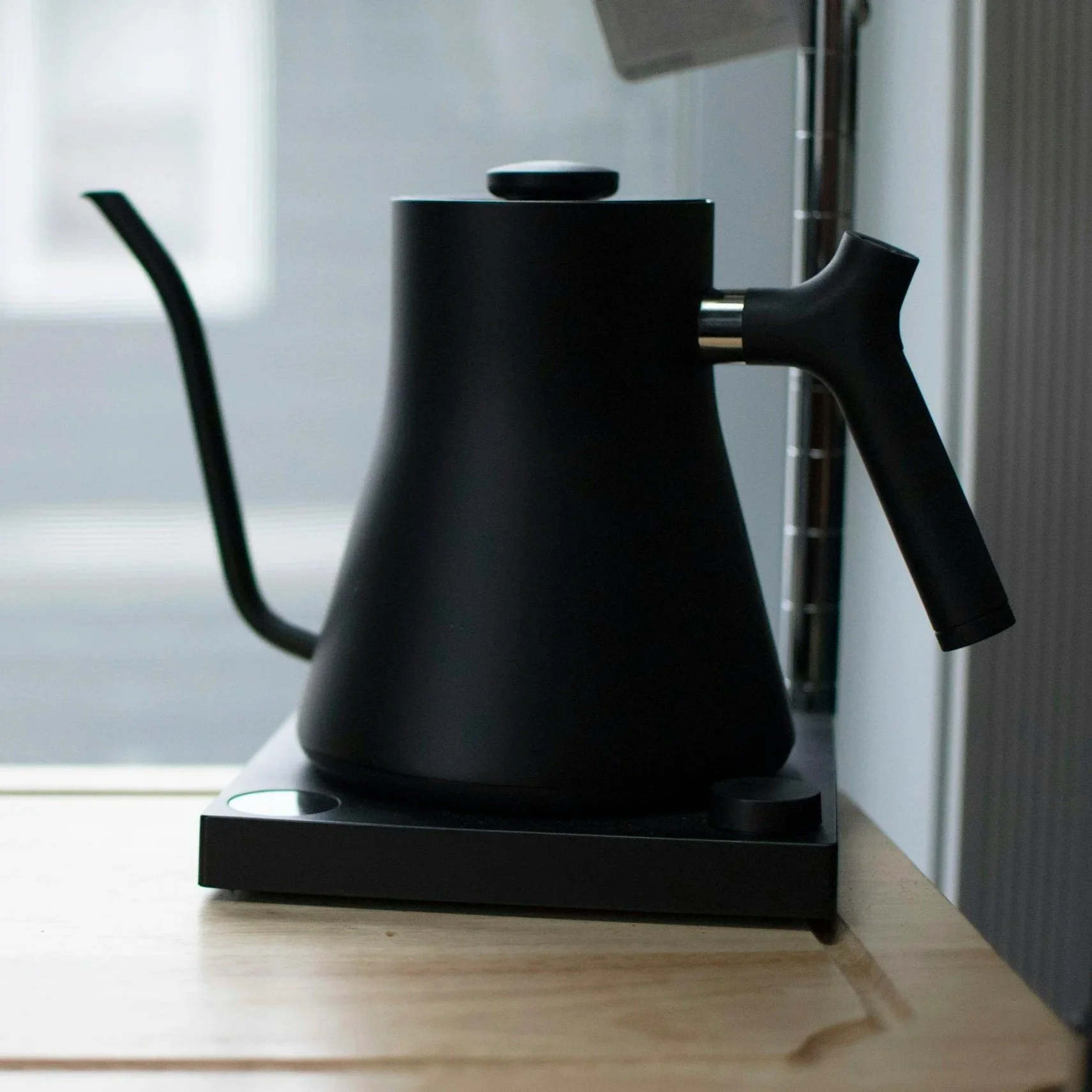
- For photography and listing optimization: shoot in a light, minimal lifestyle context (white marble, morning light, pour-over drip shot) - the Fellow Stagg aesthetic dominates search; a clean premium lifestyle image converts better than product-only white backgrounds in this category
Red Flags to Avoid
- Sub-$30 commodity race: The under-$30 tier is flooded with single-walled kettles from generic Chinese brands competing purely on price. Amazon reviews here are brutal (leaking, painting peeling, sensors dying within months). Margin is sub-15% and return rates can hit 12-18%. Avoid unless you are testing with a single ASIN and have near-zero capital at risk.
- No-temperature-control models marketed to pour-over buyers: Community forums are explicitly calling this out. Buyers who understand pour-over coffee will leave 1-star reviews if a kettle cannot hold temperature - this is a trust and review-score destroyer. Only source with PID/variable temp as a baseline feature.
- Cork or novelty handle materials: Cork handles absorb water and degrade. Painted metal finishes peel. Community feedback on Bodum and similar models cites these failures repeatedly. 304 stainless steel interior with a silicone or BPA-free ergonomic handle is the only defensible material spec in 2025.
Best Entry Point for New Sellers
Recommended Product: 1.0L Variable-Temperature Electric Gooseneck Kettle, 304 SS interior, PID ±1°F, 1200W, 2-hour keep-warm, auto shut-off, double-walled exterior
Primary Marketplace: Amazon FBA Secondary Marketplace: Shopify DTC / TikTok Shop
Target Price Range: $54.99-$74.99 retail
Startup Cost Breakdown:
| Item | Estimated Cost |
|---|---|
| Inventory (200 units @ $14/unit landed) | $2,800 |
| Amazon FBA setup + first-month fees | $450 |
| Product photography (lifestyle + infographic) | $400 |
| Shopify store setup (basic) | $200 |
| PPC launch budget (4 weeks) | $800 |
| Packaging design (private label) | $350 |
| Certification verification (ETL/UL review) | $250 |
| Total estimated launch cost | $5,250 |
Why this works: The $54-$75 price tier is where 60-65% of retail revenue is generated in this category. Buyers in this range are committed to quality but price-sensitive enough to skip Fellow Stagg ($180). A well-positioned private label that addresses the four documented complaint clusters (leaking, temperature inaccuracy, short keep-warm timers, cheap exterior finishes) can realistically achieve a 4.2-4.5 star rating within 90 days of consistent sales. At a landed cost of $14-$18 per unit and a $64.99 retail price, Amazon FBA margins run 38-44% after fees.
2. Quick Data Scans: Marketplace Sales Opportunity Analysis
| Marketplace | Opportunity Score | Product Segment | Est. Weekly Unit Sales | Est. Weekly Revenue | Avg Price Range | Est. Profit Margin |
|---|---|---|---|---|---|---|
| Amazon FBA eBay Cat: 133705 – Small Kitchen Appliances > Tea Kettles |
9/10 | Variable-temp electric, $45-$85 | 1,800-3,200 | $108,000-$208,000 | $54.99-$84.99 | 38-48% |
| 7/10 | Stovetop SS with thermometer, $25-$45 | 600-1,100 | $18,000-$44,000 | $29.99-$44.99 | 42-55% | |
| 3/10 | No-temp-control electric, sub-$30 | 2,200-4,000 | $55,000-$100,000 | $24.99-$32.99 | 8-15% (returns erode further) | |
| TikTok Shop | 8/10 | Aesthetic/lifestyle electric, $49-$69 | 400-900 | $22,000-$58,000 | $49.99-$69.99 | 36-44% |
| 6/10 | Bundle (kettle + accessories), $59-$89 | 150-350 | $10,000-$28,000 | $64.99-$89.99 | 40-52% | |
| Shopify DTC | 8/10 | Brand-story premium, $59-$89 | 80-200 | $5,000-$16,000 | $59.99-$89.99 | 48-60% |
| 6/10 | Pour-over starter bundle, $79-$119 | 30-80 | $2,500-$9,000 | $79.99-$119.99 | 44-58% | |
| eBay Cat ID: 133705 |
6/10 | Variable-temp electric, $40-$70 | 250-500 | $12,000-$30,000 | $39.99-$69.99 | 28-38% |
| 5/10 | Stovetop, collectibles, open-box | 100-250 | $2,500-$8,000 | $24.99-$44.99 | 22-32% | |
| Walmart Marketplace | 6/10 | Mass-market electric, $29-$59 | 300-700 | $10,000-$32,000 | $34.99-$59.99 | 22-30% |
| Target Plus | 5/10 | Design-forward electric, $49-$79 | 100-250 | $5,000-$18,000 | $49.99-$79.99 | 24-34% |
| Etsy | 7/10 | Gift bundles, artisan/handmade story | 80-200 | $6,000-$18,000 | $64.99-$109.99 | 40-55% |
| Instagram Shopping | 6/10 | Aesthetic lifestyle models, $54-$79 | 50-150 | $3,000-$11,000 | $54.99-$79.99 | 38-50% |
| Amazon Business B2B | 6/10 | Commercial/cafe supply, $59-$99 | 60-180 | $4,000-$16,000 | $64.99-$99.99 | 32-42% |
| Alibaba B2B Export | 8/10 | OEM private label sourcing | 500-2,000 (MOQ basis) | $7,500-$30,000 | $3.05-$15.00/unit (factory) | Sourcing vehicle; margin set at retail |
Opportunity Score Legend:
- 8-10: High demand, low-moderate competition (ENTER NOW)
- 5-7: Moderate demand, moderate competition (TEST CAREFULLY)
- 1-4: Low demand or oversaturated (AVOID)
3. Deeper Context: Market Landscape & Buyer Intelligence
A. Market Overview
Category Definition & Size
The gooseneck kettle is defined by its elongated, curved spout that restricts water flow to 17-40ml/second, enabling the controlled pouring technique required for specialty brewing methods including V60 pour-over, Chemex, AeroPress, and high-grade loose-leaf tea preparation. The category spans two core product types: electric (plug-in, with heating element and base) and stovetop (induction or flame-heated). Within electric, the primary segmentation is temperature-controlled (variable, PID-based) versus single-temperature (boil-only).
The global electric gooseneck kettle market is valued at approximately $1.2 billion in 2023 with projections toward $2.5 billion by 2032 at a CAGR of 8.5%. The broader electric kettle market (which includes gooseneck as the fastest-growing segment) was valued at $1.88 billion in 2024 and is projected to reach $3.12 billion by 2033. Capacity segments divide at under-1L (compact, gifting-friendly) and 1-1.5L (standard home use). The residential segment dominates but commercial cafe and hotel supply represents an emerging B2B channel.
Seasonal patterns are pronounced: Q4 (October-December) accounts for 35-40% of annual volume on gifting demand. A secondary peak runs February through April driven by home-brewing adoption from the new year resolution and spring gifting cycles. July and August are the lowest-volume months.
Product Evolution & Recent Trends
Gooseneck kettles shifted from a niche barista tool to a household-recognized kitchen category during the specialty coffee boom of the mid-2010s. The Fellow Stagg EKG (launched ~2017, now at $179.95) established the design archetype: flat-bottomed cylindrical body, counterbalanced handle, LCD display, precision spout. By 2022-2023, the aesthetics of this design had been widely cloned at the $40-$80 tier.
Current innovation is concentrated in three areas. First, PID temperature control accuracy - brands advertising ±1°F precision are differentiating against ±5°F generic models. Second, connectivity - Bluetooth-enabled scheduling (seen in Stagg EKG Pro at ~$399) is a premium niche but signals where the category is heading. Third, material quality signaling - 304 stainless steel interiors (versus BPA-free plastic liners), double-walled exteriors, and food-grade finish specifications are becoming table-stakes claims in the $50+ segment as buyers grow more sophisticated.
The smart kitchen integration angle (WiFi/Bluetooth, scheduling, voice assistant compatibility) is growing but currently accounts for a small fraction of unit volume. Most buyers in the $50-$90 tier want reliable hardware over connectivity features.
Leading Brands & Market Disruptors
Fellow (Stagg EKG family) is the aspirational brand anchor at $130-$399. OXO Brew ($74-$90) is the accessible quality benchmark. Bonavita ($65-$90) was the dominant mid-market brand before brand restructuring in 2021 created customer service gaps that community forums actively reference. COSORI ($50-$80) is the most aggressive private-brand competitor with strong Amazon FBA execution and review velocity. Hario (Japan, stovetop-focused) holds the professional barista credibility segment.
Private label opportunity exists in the $45-$75 gap between COSORI and OXO. Brands that can demonstrate verified temperature accuracy, leakproof construction, and 2-year warranties can realistically challenge the current review leaders within 12-18 months of consistent listing management.
Price Tiers & Popular Brands
Tier 1 - Entry ($20-$35): No-temp-control, single-wall, basic auto-shutoff. Brands: Chefman (basic), Hamilton Beach, Hamilton Beach Compact. Margins: 10-18%. Sourcing: generic factory, MOQ 500+. High return risk.
Tier 2 - Mid-Budget ($36-$55): Variable temp, single-wall, 304 SS interior. Brands: COSORI (entry), Chefman TrueTemp, TINANA. Margins: 28-38%. Sourcing: mid-tier Guangdong factories, MOQ 200-300.
Tier 3 - Volume Sweet Spot ($56-$85): Variable temp, double-wall, PID ±1°F, 1200W+, 2-hour keep-warm. Brands: COSORI Pro, OXO Brew, Bonavita Variable. Best private label target. Margins: 38-52%. Sourcing: premium Guangdong OEM, MOQ 200-500, ETL/UL certification available.
Tier 4 - Premium ($86-$150): Design-forward, high-precision, extended warranty. Brands: Brewista Artisan, Timemore, KitchenAid Precision. Margins: 42-55% at retail.
Tier 5 - Aspirational ($150+): Fellow Stagg EKG ($179.95) and EKG Pro (~$399). Counterbalanced handle engineering, full LCD, app connectivity. Not replicable at private label economics.
B. Buyer Persona Deep Dive
Persona 1: The Home Pour-Over Convert (Primary Volume Buyer)
Demographic: 26-40, 60% male, urban or suburban, college-educated, $55K-$95K household income Purchase motivation: Replicating cafe-quality V60 or Chemex at home; has already purchased a grinder or dripper and is completing the setup Price sweet spot: $49-$74 Pain points:
- Bought a "pour-over kettle" without temperature control and discovered mid-brew it was useless for specialty coffee
- Temperature readout drifts after 3-4 months of daily use (sensor fouling from limescale)
- Annoying keep-warm beeps; wants a mute function
- Can't tell from listing photos whether the interior is stainless or plastic
- Spout drips on the counter after every pour What they solve for: Consistency. They want the same cup every morning without guesswork. Decision factors: Review count + rating, clear temperature range specifications, lifestyle photography showing V60 setup Brand loyalty: Low to medium - will switch if a competitor offers a better warranty
Persona 2: The Gift-Giver for a Coffee Person
Demographic: 35-60, 55% female, buying for a partner, sibling, or parent who drinks specialty coffee Purchase motivation: Gifting occasion (birthday, Christmas, Father's/Mother's Day), wants to look like they understand the recipient's hobby Price sweet spot: $59-$89 (slightly higher because it's a gift - willing to pay the "it looks impressive" premium) Pain points:
- Overwhelmed by specs; doesn't know the difference between variable temp and fixed temp
- Worried about buying a "bad" one and looking cheap
- Wants good packaging or gift-ready presentation
- Can't tell which brands are legitimate vs Amazon generic What they solve for: Confidence in the purchase. The box has to look premium at unwrapping. Decision factors: "Best gift for coffee lovers" search, high overall review score, good product images, "gift-ready packaging" call-out Brand loyalty: Very low; will buy whatever ranks top with 4.5+ stars in their search
Persona 3: The Serious Tea Drinker
Demographic: 30-60, 65% female, often health-conscious, interested in green, white, or oolong teas that require sub-boiling temperatures (160-185°F) Purchase motivation: Stopped burning delicate teas with a standard boil kettle; wants precise degree control for different tea types Price sweet spot: $54-$79 Pain points:
- Most listings show coffee imagery - she's buying for tea but uncertain if the product is calibrated for coffee-only temperatures
- Keep-warm timers too short (30-minute shutoff) for a morning tea ritual that spans an hour
- Confusing preset labels that reference coffee drinks, not tea types
- Lid design that drips condensation back into the kettle What they solve for: Temperature precision across a wider range (140-212°F) with reliable hold function Decision factors: Temperature range advertised (must show 140-176°F options explicitly), keep-warm duration, capacity (1L+ preferred for multiple cups) Brand loyalty: Medium-high; once she finds a kettle that works for her tea ritual, she becomes a loyalist
Persona 4: The Budget-Conscious New Brewer
Demographic: 21-30, 52% male, recently bought a bag of specialty coffee or started watching pour-over YouTube content, first gooseneck purchase Purchase motivation: Saw that a gooseneck is required for pour-over; looking for the cheapest option that isn't embarrassing Price sweet spot: $28-$44 Pain points:
- Buys the cheapest option and gets no temperature control - later learns it matters
- Confused by the volume of similar-looking products at similar prices
- Gets a leaking kettle and doesn't bother to return it - just leaves a 1-star review
- Paint peels on the base within 3 months What they solve for: Entry-level access to pour-over brewing without overspending Decision factors: Price above all else, but overall rating is secondary filter - won't buy below 4.0 stars regardless of price Brand loyalty: None; will upgrade in 12-18 months once they understand what they need
Persona 5: The Cafe Owner / Small Commercial Buyer
Demographic: 30-55, 50% female, owns or manages a specialty cafe, food truck, or pop-up brunch operation with 2-8 brewing stations Purchase motivation: Needs consistent, durable kettles for staff use; price per unit matters because buying 3-6 at a time Price sweet spot: $55-$90/unit; happy to pay for reliability and warranty Pain points:
- Kettles in commercial use fail faster than the manufacturer suggests - 6-12 months vs 3+ years expected
- Temperature calibration drifts under heavy daily use
- No easy B2B purchasing path - has to buy through Amazon like a consumer
- Returns and warranty claims are slow/unresponsive from generic brands What they solve for: Uptime. A broken kettle during peak morning hours is a service failure. Decision factors: Warranty length (wants 2+ years), brand's documented customer service responsiveness, bulk purchase discount Brand loyalty: High once trust is established; will become a repeat commercial buyer
Persona 6: The Aesthetic-First Kitchen Curator
Demographic: 25-38, 70% female, highly active on Instagram or Pinterest, coffee is partly a lifestyle prop Purchase motivation: The kettle lives on the counter - it needs to look good. Brewing quality is secondary to visual appeal. Price sweet spot: $49-$79 Pain points:
- Most variable-temperature kettles are black and utilitarian-looking
- "Rosegold" or "sage green" color options that don't match the listing photos in reality
- Exterior finishes that fingerprint badly or dull after 6 months
- Beeps and indicator lights that disrupt the calm morning aesthetic What they solve for: A kettle that photographs well and fits a curated counter aesthetic Decision factors: Color range, lifestyle photography in listing, social proof (influencer mentions), matte finish options Brand loyalty: Medium; will switch when she redecorates her kitchen or finds a better-looking option
Persona 7: The Upgrade Seeker (Current Gooseneck Owner Replacing a Failed Unit)
Demographic: 28-50, 55% male, has owned at least one gooseneck kettle that failed (leaking, sensor failure, base connection fault) Purchase motivation: Replacement purchase driven by frustration; not a first-time buyer Price sweet spot: $59-$89 - willing to pay more than last time to avoid the same problems Pain points:
- Previous kettle leaked from the gooseneck junction within 6 months
- Temperature sensor failed or began reading inaccurately
- Base connection became intermittent (kettle wouldn't turn on reliably)
- Contacted brand support and got no response or a runaround What they solve for: Durability and customer service accountability Decision factors: Explicit warranty duration, verified 304 SS interior, brand's responsiveness on Amazon Q&A/reviews, ETL/UL certification prominently listed Brand loyalty: Very low to their previous brand; will specifically research to avoid repeating the failure
C. Keyword & Search Trends
Google Trends & Search Volume
Top monthly search terms (US, estimated Google search volume):
| Keyword | Est. Monthly Searches | Trend |
|---|---|---|
| gooseneck kettle | 110,000-135,000 | Stable/growing |
| electric gooseneck kettle | 60,000-90,000 | Growing |
| best gooseneck kettle | 40,000-55,000 | Growing |
| pour over kettle | 35,000-50,000 | Stable |
| gooseneck kettle with temperature control | 18,000-28,000 | Strong growth |
| Fellow Stagg EKG | 22,000-35,000 | Brand anchor |
| pour over coffee kettle | 14,000-22,000 | Stable |
| stovetop gooseneck kettle | 8,000-14,000 | Slight decline |
| kettle for pour over coffee | 10,000-16,000 | Growing |
| gooseneck tea kettle | 12,000-18,000 | Growing |
Seasonal peaks align with Q4 (November spike largest, driven by holiday gift searches) and a secondary peak in January-February as new year home-brewing resolutions drive category discovery. The "best gooseneck kettle 2025" long-tail sees a major spike each November-December.
Seasonal Demand Patterns
Window 1 - Q4 Peak (October 15 to December 31): 35-40% of annual volume. Gift-driven. Buyer skews toward gift-giver persona; mid-tier price point ($59-$89) outperforms. Bundle listings (kettle + accessories) over-index. PPC costs rise 20-35% - plan budgets accordingly.
Window 2 - New Year Resolution (January to February): 18-22% of annual volume. Self-purchase dominant. Home barista persona is primary buyer. Pour-over starter kit messaging converts well.
Window 3 - Spring/Mother's Day (April to May): 12-15% of annual volume. Gift search returns; feminine aesthetic models and tea-focused messaging outperform. Single-serve sizes (0.8-0.9L) over-index.
Rising vs. Declining Queries
Rising (2024-2025):
- "gooseneck kettle temperature control" (+38% YoY) - buyers learning why temp matters
- "double wall gooseneck kettle" (+52% YoY) - safety awareness from burn complaints
- "gooseneck kettle 304 stainless steel" (+44% YoY) - material literacy growing
- "gooseneck kettle UL certified" (+31% YoY) - safety certification discovery
- "gooseneck kettle keep warm 2 hours" (+29% YoY) - pain point driving specific search
- "pour over kettle with timer" (+41% YoY) - integrated functionality demand
- "sage green gooseneck kettle" (+67% YoY) - aesthetic color trend
- "gooseneck kettle tea" (+22% YoY) - market expanding beyond coffee core Declining:
- "stovetop kettle pour over" (-18% YoY) - electric consolidating the category
- "gooseneck kettle Bonavita" (-24% YoY) - brand trust erosion post-restructuring
- "kettle thermometer separate" (-15% YoY) - integrated temp control winning
- "basic gooseneck kettle" (-11% YoY) - buyers moving upmarket
Consumer Insights from Community Forums
Analysis of r/Coffee, r/tea, r/pourover, and buyer forum communities across Slickdeals and Amazon Q&A surfaces four dominant complaint clusters that define private label opportunity:
Complaint Cluster 1: No Temperature Control Sold as Pour-Over Tool This is the single most recurring frustration. Buyers receive a gooseneck kettle that cannot control temperature and discover post-purchase that this is essential for pour-over coffee. Community members explicitly warn newcomers: "this does NOT have temperature control, which is pretty important." Listings that bury or omit this spec generate the most negative reviews. Seller opportunity: Feature variable temperature control as the headline claim (not a bullet point) with the specific range advertised (140-212°F or equivalent).
Complaint Cluster 2: Leaking Gooseneck Junctions and Base Connections Across Bodum, Chefman, and generic brands, leaking is the dominant 1-star review trigger. One community member noted: "I couldn't get it to stop leaking...mine leaked even when below the fill line." Another observed that Mecity updated their manufacturing specifically to address leak failures. The complaint extends to water accumulating in the base cavity. Seller opportunity: Source specifically with a leak-proof tested design; use this as a listing differentiator with "leak-proof guarantee" and offer 30-day return on this specific failure mode.
Complaint Cluster 3: Temperature Sensor Failure and Drift From forum analysis: "a year ago the temp controller started jumping all over the place" and "temperature keeps reading 3-5 degrees higher than actual" after limescale buildup. Sensor failure is both a manufacturing quality issue (cheap sensors) and a maintenance literacy issue (buyers don't descale). Temperature probe failure was also the catalyst for a widely cited Trustpilot complaint about a brand refusing refunds after its kettle "stopped reading the temperature." Seller opportunity: Source with stainless steel mechanical temp sensors (not plastic probe sensors); include a descaling instruction card in packaging; market "±1°F guaranteed accuracy."
Complaint Cluster 4: Cheap Exterior Finishes and Material Degradation Paint peeling from metal bases, cork handles absorbing water and deteriorating, silver-on-black color discontinuities that look cheap in person, and fingerprint-prone gloss finishes are repeated aesthetic disappointments. One buyer noted: "the black paint is peeling off." Another dismissed a well-priced kettle: "the silver looks pretty ugly." Seller opportunity: Specify matte powder-coat or brushed stainless exterior finishes; avoid painted bases; test cork vs. silicone handle durability before committing to a design.
4. Tools & Resources: Sourcing Decision Framework
Private Label Sourcing Calculator
| Product Type | Factory Price | MOQ | Shipping (per unit) | Duties | Landed Cost | Amazon Fees | Total Cost | Retail Price | Profit Margin |
|---|---|---|---|---|---|---|---|---|---|
| Basic Stovetop SS Gooseneck 1.0L, 304 SS, no electric, induction-compatible |
$4.50 | 300 | $2.80 | $0.55 (HTS 7323.93) | $7.85 | $8.40 | $16.25 | $34.99 | 53.6% |
| Stovetop SS + Built-In Thermometer 1.2L, 304 SS, dial thermometer, induction |
$6.80 | 300 | $3.20 | $0.80 | $10.80 | $10.50 | $21.30 | $44.99 | 52.6% |
| Electric - Basic Variable Temp 0.8L, 5 presets, 1000W, auto shut-off, ETL |
$9.50 | 200 | $4.20 | $1.15 (HTS 8516.40) | $14.85 | $14.40 | $29.25 | $54.99 | 46.8% |
| Electric - PID ±1°F Variable Temp (Core Recommendation) 1.0L, 1200W, 2hr keep-warm, double-wall, 304 SS interior, ETL |
$13.50 | 200 | $4.80 | $1.60 | $19.90 | $17.60 | $37.50 | $64.99 | 42.3% |
| Electric - Premium Design (Matte Finish, Color Options) 1.0L, 1500W, 6 presets, matte powder coat, silicone handle, brew timer, ETL |
$15.00 | 300 | $5.20 | $1.80 | $22.00 | $19.60 | $41.60 | $74.99 | 44.5% |
| Pour-Over Bundle (Electric Kettle + V60 Dripper + 40 Filters) Gift box packaging, kettle (1.0L PID) + Hario-style V60 + filter pack |
$17.80 | 150 | $6.50 | $2.10 | $26.40 | $22.40 | $48.80 | $89.99 | 45.8% |
Bundle & Cross-Sell Strategy Table
| Bundle Type | Components | Bundle Price | AOV Lift | Best Channel | Seasonal Window |
|---|---|---|---|---|---|
| Pour-Over Starter Kit | 1.0L electric kettle + V60 dripper + 40 filters | $84.99-$99.99 | +38-55% | Shopify DTC, Etsy, Amazon Bundle | Q4, Jan-Feb |
| Tea Ceremony Set | Stovetop gooseneck + tea infuser + gongfu tray | $59.99-$74.99 | +48-65% | Etsy, Instagram Shopping | Q4, Mother's Day |
| Precision Brewing Duo | 1.0L electric PID kettle + digital coffee scale | $94.99-$114.99 | +55-70% | Shopify DTC, TikTok Shop | Q4, Jan |
| Descaling Maintenance Pack | Replacement purchase: kettle + citric acid sachets (6-pack) + cleaning brush | $69.99-$79.99 | +18-28% | Amazon (replacement buyer targeting) | Year-round |