
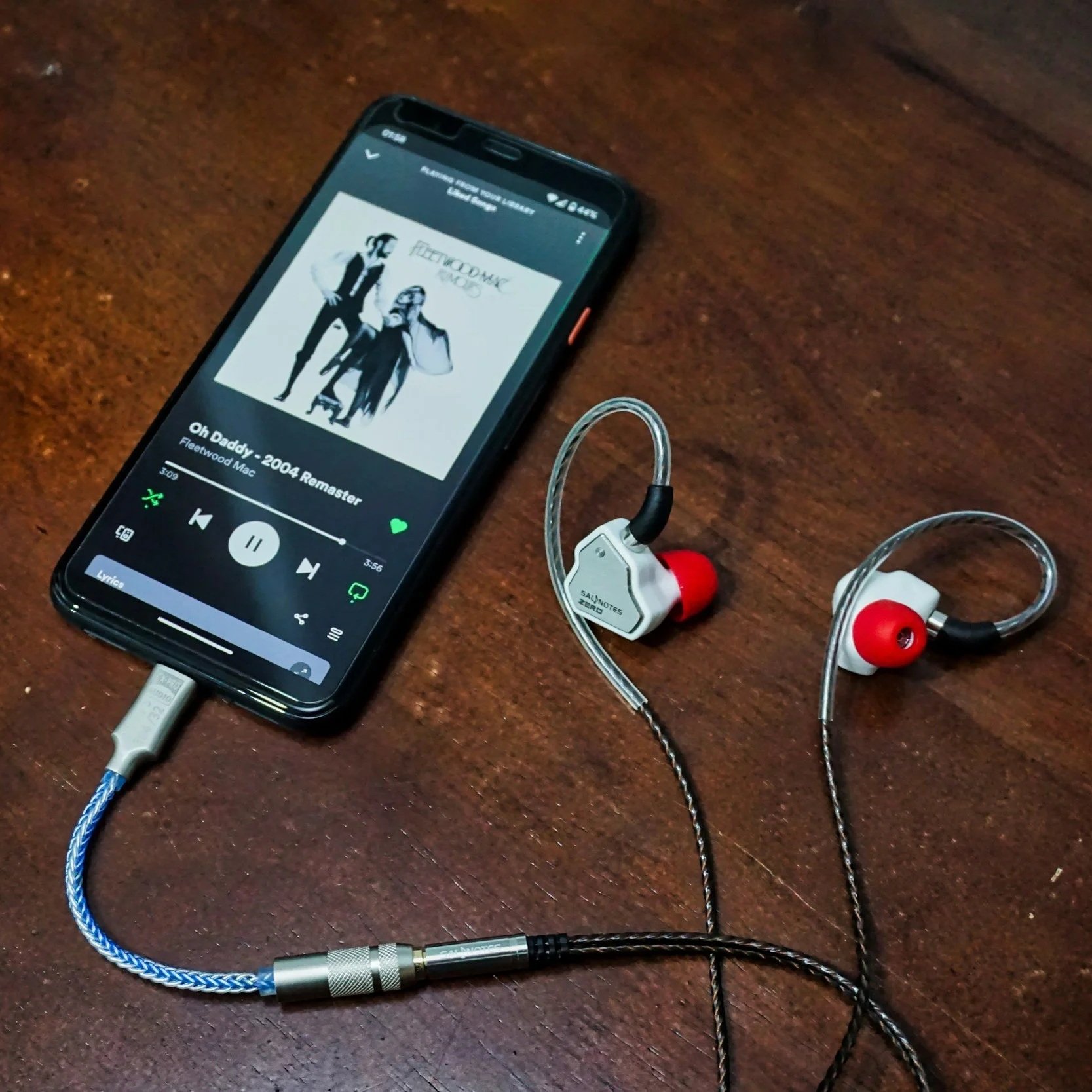
Article Summary: Key Insights at a Glance
- The mobile phone headphone amp category, better known to buyers as the dongle DAC or portable DAC amp, sits inside a global DAC headphone amplifier market that published research places between $420 million and $1.2 billion, growing at roughly 7% to 9% a year. Our working estimate for the phone-focused portable slice is $480 million to $620 million in 2026.
- The headphone jack is now effectively extinct on flagship phones, and every iPhone since the 15 series uses USB-C. That single change turned the whole iPhone base into potential USB-C dongle buyers and quietly killed demand for Lightning-only adapters.
- Lossless streaming is now mainstream across the big three platforms, which gives casual listeners a reason to care about the output stage for the first time. The category is no longer just an audiophile niche.
- The market has split cleanly in two. Generic sub-$15 dongles built on the same few Chinese chipsets are saturated and commoditised, while enthusiast brands such as FiiO, Moondrop, Fosi, iFi, Qudelix and iBasso own the $50 to $150 tier on reputation and published measurements.
- Buyer complaints cluster into five repeatable themes: audible hiss with sensitive in-ear monitors, phone battery drain and "accessory uses too much power" warnings, iPhone features that do not work as advertised (mic, inline controls, volume steps), fragile fixed cables that fail at the strain relief, and random disconnects or phone-specific noise.
- The biggest private label opening is not a louder or more expensive amp. It is an honest-compatibility dongle in the $20 to $35 range: low noise floor for IEMs, a detachable cable, a published phone compatibility list and clear statements about what does not work.
- Pass-through charging DACs and connection accessory kits (short OTG cables, cases, magnetic clips) are the most under-served segments, with estimated net margins of 34% to 42% before advertising on Amazon.
- Private label at the flagship Bluetooth and $100+ tier is viable but capital-heavy. Radio certification, firmware and app support create real barriers, and the landed cost of Chinese electronics now carries a stacked tariff burden of roughly 37.5% on top of base duty in the US.
- Seasonality is moderate but predictable. Demand lifts with the September phone launch window, peaks through Black Friday to Christmas, and gets a second push from the Prime Day and 11.11 shopping events.
- The best entry point for a new seller in 2026 is a low-noise IEM dongle bundled with a connection kit, sold on Amazon, TikTok Shop and eBay, with a total startup budget of roughly $9,600 to $14,850.
1. Actionable Insights First: Executive Opportunity Summary
Top 3 Selling Opportunities Right Now
Opportunity 1: The honest-compatibility low-noise IEM dongle
Opportunity Score: 9/10
The single loudest complaint in this category is not about sound quality in the audiophile sense. It is about hiss. Budget in-ear monitors from brands like Moondrop, Truthear and Kiwi Ears are highly sensitive, and many dongles that measure well into full-size headphones produce an audible background noise the moment an IEM is plugged in. Buyers then blame the IEM, the phone or themselves, and the return follows.
A dongle that is tuned for a low noise floor, ships with a detachable USB-C cable, and publishes both its output noise figure and a tested phone compatibility list solves the three biggest frustrations at once. Enthusiast brands already do this in the $50 to $130 range. Almost nobody does it convincingly at $20 to $35, where the generic listings compete on chip names and "Hi-Res" logos rather than proof.
- Profit margin range: 33% to 38% net before advertising
- Typical FOB: $4.20 to $6.50 per unit
- Typical retail: $22.99 to $34.99
- Growth signal: budget IEMs are the fastest-growing entry point into wired audio, and every one of those buyers needs a source that does not hiss
Opportunity 2: Pass-through charging DAC dongles
Opportunity Score: 8/10
Battery drain is the second biggest complaint cluster. A bus-powered dongle draws current from the phone, and high-output models can trigger power warnings on iPhones or cut out at high volume. The obvious answer is a dongle with a USB-C Power Delivery charge-through port, so the listener can charge and listen at the same time. The product exists, but most versions are generic, poorly documented about which phones support simultaneous charging and audio, and carry no noise specification at all.
This is also the go-to product for commuters on long flights, mobile gamers who play for hours, and drivers who use a wired aux input. It is a practical purchase, not an audiophile one, which makes it far easier to sell to a mainstream audience.
- Profit margin range: 32% to 36% net before advertising
- Typical FOB: $5.80 to $8.50 per unit
- Typical retail: $26.99 to $39.99
- Growth signal: the shift of every major phone line to a single USB-C port means the charge-or-listen conflict now affects nearly every wired listener
Opportunity 3: Connection accessory kits and bundles
Opportunity Score: 8/10
The accessories surrounding a portable DAC amp are the quietest profit pool in the category. Owners of battery-powered DAC amps and larger dongles constantly search for short right-angle USB-C to USB-C cables, Lightning to USB-C OTG cables for older iPhones, silicone or leather cases, and magnetic or elastic straps that hold the amp to the back of the phone. Branded versions are expensive and often out of stock; generic versions are frequently the wrong type of cable, lacking the data lines or OTG wiring that a DAC needs.
A curated, clearly labelled kit that states exactly which cable does what, and which phones it works with, turns a confusing purchase into a one-click decision. Returns are low, competition is fragmented, and the kit attaches naturally to any dongle sale.
- Profit margin range: 38% to 45% net before advertising
- Typical FOB: $1.80 to $3.20 per kit
- Typical retail: $16.99 to $24.99
- Growth signal: every battery-powered DAC amp and every Lightning iPhone still in use needs at least one correct OTG cable
Quick Action Items
- Order measurement-verified samples from at least four suppliers of low-noise IEM dongles and test each one with a sensitive IEM on an iPhone 15 or later, a Samsung Galaxy S series and a Google Pixel before committing to any MOQ.
- Build a written phone compatibility matrix covering mic support, inline control support, volume behaviour and simultaneous charging. Publish it in the listing and on the packaging insert.
- Specify a detachable USB-C cable in the factory order. The fixed cable is the most common physical failure point in this category.
- Budget for FCC Part 15 testing and a Declaration of Conformity for any digital USB audio device sold in the US, plus CE and UKCA documentation for Europe and the UK.
- Launch with a bundle, not a single SKU. Pair the dongle with the connection kit and a short IEM-friendly cable to lift average order value and differentiate from single-item generic listings.
- Time the launch for late October stock arrival if using air freight, so listings have reviews before Black Friday.
- Price above the $15 commodity floor on purpose. Competing with generic CX31993 listings at $9.99 to $14.99 is a race to zero with no defensible story.
Red Flags to Avoid
- "Hi-Res" logo and chip-name marketing with no measurements. Buyers in this category read reviews from measurement-focused communities. Unverified claims about SNR and THD get called out quickly and damage a new brand permanently.
- MQA as a headline feature. The major streaming platform that championed MQA moved to standard lossless FLAC in 2024, and the format has lost most of its relevance. Listing it as a key benefit now signals an outdated product.
- Claiming iPhone call or mic support without testing. Microphone and inline control behaviour through USB DACs varies by phone and chipset. Unverified claims are a direct route to one-star reviews.
- Bluetooth products without a certification budget. Anything with a radio requires intentional radiator FCC certification, which costs several thousand dollars and takes weeks. Do not source Bluetooth DAC amps from suppliers who cannot supply existing certification reports.
- Lightning-only products. New iPhones have not used Lightning since 2023. Lightning DAC stock is a clearance item, not a growth line.
- Counterfeit or clone listings of known brands. Enthusiast brands in this category are active in protecting their designs, and marketplace takedowns are common.
- Ignoring tariff volatility. US duty on Chinese-origin electronics changed several times between 2025 and 2026. A landed cost model built on last year's rates can erase margin overnight.
Best Entry Point for New Sellers
The recommended entry point is Configuration B (the low-noise IEM dongle) bundled with Configuration G (the connection accessory kit), launched on Amazon US, TikTok Shop and eBay.
This entry point works for three reasons. First, it targets the most common and least solved complaint, which is hiss with sensitive IEMs, rather than competing on raw power where the enthusiast brands are strongest. Second, it sits in the $25 to $40 bundle price band, above the commodity floor but below the price where buyers default to a known brand. Third, it does not require radio certification, firmware development or an app, which keeps both capital and technical risk low for a first import.
Estimated startup cost breakdown:
| Cost Item | Estimated Range | Notes |
|---|---|---|
| Samples from 4 to 6 suppliers | $250 to $450 | Include shipping. Test on at least three phone brands |
| Measurement setup | $300 to $600 | USB audio interface and IEM coupler for noise and output checks |
| Inventory: Config B, 500 units | $3,700 to $4,200 | Landed cost including freight and duty |
| Inventory: Config G, 500 kits | $2,000 to $2,400 | Landed cost including freight and duty |
| FCC Part 15B testing and SDoC | $1,000 to $2,500 | Required for digital USB audio devices sold in the US |
| Packaging design and inserts | $300 to $700 | Includes printed compatibility card |
| Product photography and short video | $500 to $1,000 | Short-form video is essential for TikTok Shop |
| Trademark filing and brand registry | $350 to $1,000 | Needed for Amazon Brand Registry protection |
| Launch advertising, first 60 days | $1,200 to $2,000 | Sponsored Products plus TikTok creator samples |
| Total | $9,600 to $14,850 | A lean version with fewer samples and self-shot content lands near $9,500 |
The alternative entry point, importing a battery-powered Bluetooth DAC amp, fails on cost and risk. Certification, firmware updates and app maintenance all fall on the brand, and the leading products from FiiO and Qudelix already set a very high bar for features and software support at prices a new importer cannot undercut credibly.
2. Quick Data Scans: Marketplace Sales Opportunity Analysis
Legend
| Score Range | Meaning | Action |
|---|---|---|
| 8 to 10 | High demand, low to moderate competition | Enter now |
| 5 to 7 | Moderate demand, moderate competition | Test carefully |
| 1 to 4 | Low demand or oversaturated | Avoid |
Marketplace Opportunity Matrix
| Marketplace | Opportunity Score | Product Segment | Est. Weekly Unit Sales | Est. Weekly Revenue | Avg Price Range | Est. Profit Margin |
|---|---|---|---|---|---|---|
| Amazon US | 9 | Low-noise IEM dongles ($20 to $35, published noise and compatibility) | 180 to 320 | $4,100 to $11,200 | $22.99 to $34.99 | 33% to 38% |
| 8 | Pass-through charging DACs (PD charge port plus 3.5mm) | 120 to 240 | $3,200 to $9,600 | $26.99 to $39.99 | 32% to 36% | |
| 8 | Connection kits and cases (OTG cables, straps, pouches) | 150 to 300 | $2,500 to $7,500 | $16.99 to $24.99 | 38% to 45% | |
| 3 | Generic entry dongles (CX31993 class, under $15) | 300 to 600 | $2,700 to $9,000 | $8.99 to $14.99 | 8% to 22% | |
| Amazon UK and DE | 7 | Low-noise dongles and charging DACs | 60 to 140 | $1,600 to $5,900 | £/€21 to £/€35 | 28% to 34% |
| Amazon AU | 7 | Dongles and connection kits | 35 to 80 | $740 to $2,900 | A$32 to A$55 | 28% to 35% |
| eBay US | 8 | New bundles and kits (dongle plus cable plus case) | 60 to 130 | $1,700 to $5,800 | $27.99 to $44.99 | 30% to 38% |
| 7 | Used and open-box enthusiast DAC amps (FiiO, iFi, Chord, Qudelix) | 10 to 25 | $1,000 to $3,500 | $60 to $450 | 20% to 35% | |
| eBay AU and UK | 6 | Dongles, kits and used portables | 25 to 60 | $500 to $2,800 | A$30 to A$60 | 26% to 33% |
| TikTok Shop US | 8 | Bundles with visible before and after demos (gaming and commute angles) | 80 to 220 | $2,000 to $8,800 | $24.99 to $39.99 | 26% to 34% |
| Walmart Marketplace | 6 | Charging DACs and iPhone switcher kits | 30 to 80 | $750 to $3,200 | $24.99 to $39.99 | 28% to 34% |
| Shopify DTC | 7 | Premium dongles plus content (measurements, pairing guides) | 15 to 50 | $600 to $5,000 | $39.99 to $99 | 40% to 52% |
| Reverb | 5 | Used portable DAC amps and creator monitoring kits | 5 to 15 | $400 to $1,800 | $60 to $300 | 18% to 28% |
| Facebook Marketplace | 5 | Local resale of used enthusiast gear | 3 to 10 | $250 to $1,500 | $50 to $400 | 20% to 35% |
| Etsy | 4 | Custom short OTG cables and handmade cases | 10 to 30 | $180 to $1,050 | $18 to $35 | 30% to 45% |
| Temu and AliExpress | 2 | Generic chipset dongles | Very high | Price-led | $3 to $12 | Under 10% |
Table Notes and Methodology
- Weekly unit and revenue figures describe a competent new seller with an optimised listing, 30 or more reviews and moderate advertising spend, not the category leaders. Established enthusiast brands sell many multiples of these figures.
- Profit margins are net of product cost, freight, duty, marketplace fees and a return allowance, but before advertising. Budget an additional 10% to 20% of revenue for advertising during the first six months.
- Amazon generic entry dongles score 3 because hundreds of near-identical listings compete on the same chipsets, the price floor sits below $10, and review volume on incumbent listings runs into the thousands.
- Used and open-box enthusiast gear on eBay scores well because buyers trust tested units with original accessories, and the category holds value better than most consumer electronics. Chord, iFi and FiiO battery units in particular resell at 55% to 75% of retail.
- TikTok Shop performs best when the content shows a clear, visible problem being solved, such as charging and listening at the same time, or a gamer hearing footsteps more clearly. Pure audiophile sound claims do not translate to short video.
- Temu and AliExpress are listed as a competitive reference. They set consumer price expectations for generic dongles and should be treated as a reason to avoid the bottom tier, not as a sales channel.
- Currency figures for UK, DE and AU channels are shown in local currency for price range and in USD equivalent for revenue.
3. Deeper Context: Market Landscape and Buyer Intelligence
A. Market Overview
Category Definition and Size
A mobile phone headphone amp is any device that takes the digital audio signal from a phone and converts and amplifies it for wired headphones or earphones, bypassing the phone's own audio output. In practice the category covers four product types: USB-C dongle DACs (small bus-powered adapters, often called dongles or cable DACs), battery-powered portable DAC amps that strap to the phone, Bluetooth DAC amps that receive a wireless signal and drive wired headphones, and a shrinking group of analogue-only portable amps that take a 3.5mm line signal.
For sellers, the key point is that almost every modern product in this category is a DAC and an amp combined. Buyers rarely search for "amp" alone any more, and phones without a headphone jack cannot feed an analogue-only amp without a DAC in between.
Published market sizing varies widely because research firms draw the boundary in different places. The ranges below show the spread.
| Source Definition | Base Year Value | Forecast Value | CAGR |
|---|---|---|---|
| DAC headphone amplifiers, narrow definition | $420 million (2024) | $830 million (2033) | 7.8% |
| Headphone amplifiers, all types | $620 million (2024) | $989 million (2031) | 6.9% |
| Headphone amplifiers, alternate estimate | $1.04 billion (2021) | $2.58 billion (2033) | 8.1% |
| DAC headphone amplifiers, broad definition | $1.2 billion (2024) | $2.4 billion (2032) | 9.2% |
| Headphone amplifiers including desktop and pro | $3.78 billion (2024) | $6.50 billion (2030) | 6.7% |
| ShelfTrend working estimate: phone-focused portable DAC amps | $480M to $620M (2026) | $800M to $1.0B (2031) | 8% to 10% |
Our working estimate isolates the portable, phone-connected slice from the narrow and mid-range definitions, then adjusts upward for the unusually strong growth in sub-$150 dongles that most published reports under-count because they track branded audio companies rather than marketplace sales of generic and enthusiast products. The portable segment is widely reported as the largest single product type, and it is growing faster than desktop units.
North America and Asia Pacific are the two largest regions. Asia Pacific, and China in particular, is both the manufacturing centre and the fastest-growing consumer market, driven by a large enthusiast community and a deep bench of domestic brands. Online channels dominate sales for this category, with specialist audio retailers and Amazon carrying most branded volume.
Product Evolution and Recent Trends
The headphone jack is gone and USB-C won. Flagship phones from every major manufacturer ship without a 3.5mm jack, and every iPhone since the 15 series uses USB-C. This matters more than any other trend in the category. It means one dongle now works across almost every current phone, tablet and laptop, which shrinks the SKU count a seller needs and widens the addressable market to include the entire iPhone base as it upgrades.
Lossless streaming made the output stage matter to normal listeners. Apple Music, Amazon Music and Tidal all offer lossless audio, and Spotify began rolling out lossless streaming to Premium subscribers in late 2025. Lossless audio cannot travel over standard Bluetooth without compression, so a listener who wants to hear what they are paying for needs a wired path. That is the single biggest mainstream demand driver.
Dongles grew up. Five years ago a dongle was a $9 adapter. In 2026 a dongle can include dual DAC chips, 3.5mm and 4.4mm balanced outputs, hardware volume buttons, a small screen and an app with parametric EQ. Products such as the FiiO KA17 and iBasso DC Elite pushed dongle output to levels that drive most full-size headphones, and even the budget tier now routinely offers 4.4mm balanced output.
App control and DSP are the new battleground. Qudelix built a following on app-based EQ, and competitors have followed. Buyers increasingly expect a companion app for gain, filters and EQ. This raises the bar for any private label product above about $60, because an app that is buggy or abandoned becomes a review liability.
Power management became a feature. Low-power modes, gain switches and USB-C power pass-through are now selling points rather than technical details, directly in response to battery drain complaints.
MQA faded. Once a common spec-sheet claim, MQA lost relevance after the main streaming service supporting it switched to standard lossless formats in 2024. Many listings still mention it, which is now a mild negative signal to informed buyers.
Leading Brands and Market Disruptors
FiiO is the category's volume leader across dongles, battery DAC amps and Bluetooth units. The KA11, KA13, KA15 and KA17 dongles cover the $30 to $130 range, and the BTR series dominates Bluetooth DAC amps. FiiO's strength is breadth, frequent updates and strong retail distribution.
Moondrop built its reputation on IEMs and extended into dongles with the Dawn series, which is popular with budget IEM buyers. It benefits from direct cross-sell to its own IEM customers.
Fosi Audio has become a value leader with the DS2, widely cited as one of the best value dongles of 2026, offering dual DACs and balanced output at a price that undercuts most competitors.
iFi Audio owns the premium-portable lifestyle position with the Go Link, Go Link Max and Hip-dac range. Its products sell partly on design and brand trust.
Qudelix is a single-product disruptor. The 5K Bluetooth DAC amp built a loyal following on its app and EQ capabilities and remains a reference point for app quality in the category.
iBasso, Cayin, Shanling and Questyle compete in the enthusiast $100 to $300 tier with high-output dongles and distinctive designs, including tube-based ultraportables.
Chord Electronics sits at the top of the portable market with the Mojo 2 and Hugo 2, sold as transportable rather than pocketable devices.
Apple and Google matter as price anchors. Apple's own USB-C to 3.5mm adapter, at around $9, is widely regarded as the cheapest acceptable source and is the benchmark every budget dongle is compared against.
Generic chipset brands such as JCALLY, BZINK, Kiwi Ears (for its AD1 cable DAC), KBEAR and dozens of unbranded sellers fill the sub-$25 space using the same small group of chipsets.
Price Tiers and Popular Brands
| Tier | Price Range | Typical Products | What Buyers Get | Seller Opportunity |
|---|---|---|---|---|
| Commodity | Under $15 | Apple and Google adapters, generic CX31993 and KT02H20 dongles | Basic 3.5mm output, fixed cable, no controls | Very low. Price war with thousands of listings |
| Budget enthusiast | $15 to $50 | FiiO KA11, Kiwi Ears AD1, JCALLY JM6 Pro, Snowsky Retro Nano | Better noise floor, some with 4.4mm, basic build | High for honest-compatibility and charging designs |
| Mid-range | $50 to $150 | Fosi DS2, Moondrop Dawn Pro, iFi Go Link Max, FiiO KA15 and KA17, Qudelix 5K | Dual DACs, balanced output, gain modes, app control | Moderate. Needs measurements and strong content |
| Enthusiast portable | $150 to $400 | FiiO BTR17, iFi Hip-dac 3, iBasso DC Elite, Questyle M15i, Shanling UP6 | High output, premium materials, Bluetooth plus wired | Low for private label. Strong for used resale |
| Transportable flagship | $400 and above | Chord Mojo 2, Chord Hugo 2 | Reference sound, desktop capable | Used and open-box only |
B. Buyer Persona Deep Dive
Persona 1: The Budget IEM Upgrader
Profile: Aged 18 to 34, commutes by public transport, recently bought a $20 to $80 set of in-ear monitors after watching reviews. Often a student or early-career professional.
Motivation: Wants to hear the improvement the reviewers promised. Has discovered that the phone adapter or wireless earbuds are not the same experience.
Pain points: Hiss with sensitive IEMs, confusion over 3.5mm versus 4.4mm, fear of buying the wrong thing, fixed cables that feel flimsy.
Buying behaviour: Researches heavily on YouTube and Reddit, buys on Amazon or AliExpress, highly price sensitive but willing to pay $10 to $15 more for proof.
Purchase trigger: A review or comment thread saying a specific dongle is quiet with their exact IEM.
What converts them: A published noise measurement, a list of tested IEM pairings, and a detachable cable.
Persona 2: The iPhone Switcher
Profile: Aged 30 to 55, recently upgraded from a Lightning iPhone to a USB-C model. Owns a drawer of wired headphones and a Lightning adapter that no longer fits.
Motivation: Just wants the wired headphones to work again, ideally with the microphone and volume buttons.
Pain points: Discovers that some adapters do not support calls, that inline buttons behave inconsistently, and that some high-power dongles trigger power warnings.
Buying behaviour: Low research, fast purchase, often on Amazon or at a big-box retailer. Reads the top three reviews and the compatibility line.
Purchase trigger: Upgrading the phone, or losing the included adapter.
What converts them: Clear statements that mic and controls work on iPhone 15, 16 and 17, a simple product name, and a price under $30.
Persona 3: The Mobile Gamer
Profile: Aged 14 to 30, plays competitive mobile titles for long sessions. Uses a wired headset for lower latency and clearer positional sound.
Motivation: Hear footsteps and cues sooner, avoid Bluetooth delay, keep the phone charged during long sessions.
Pain points: Phone battery drain, the single USB-C port being used for either charging or audio, and mic compatibility with party chat.
Buying behaviour: Discovers products through TikTok, YouTube Shorts and streamer recommendations. Responds to visible demonstrations.
Purchase trigger: Seeing a short video of someone charging and gaming with wired audio at the same time.
What converts them: A pass-through charging dongle with mic support, a right-angle plug that does not dig into the hand, and a gaming-focused bundle.
Persona 4: The Full-Size Headphone Owner
Profile: Aged 25 to 50, owns planar magnetic or high-impedance over-ear headphones used at home and occasionally on the go.
Motivation: Wants enough power from a phone or laptop to drive demanding headphones without a desktop stack.
Pain points: Dongles that run out of volume, distortion at high volume, heat, and battery drain from high-gain modes.
Buying behaviour: Reads spec sheets for output power in milliwatts, compares balanced output figures, buys from specialist retailers or Amazon.
Purchase trigger: Buying a new pair of headphones that the phone cannot drive properly.
What converts them: Verified power output at 32 and 300 ohms, balanced 4.4mm output, a high-gain mode and a clear note about battery impact.
Persona 5: The Enthusiast Collector
Profile: Aged 25 to 55, active in Head-Fi, r/headphones and r/iemgear communities, owns several dongles and DAC amps.
Motivation: Exploring different sound signatures, trying new releases, comparing measurements.
Pain points: Marketing that does not match measurements, abandoned apps, poor firmware support.
Buying behaviour: Buys new releases early, resells older units on eBay, Reverb and community classifieds. Buys and sells frequently.
Purchase trigger: A new release from a trusted brand, a strong measurement review, or a used bargain.
What converts them: Independent measurements, a transparent brand story and a working app. This persona is a supplier of used inventory as much as a customer.
Persona 6: The Mobile Creator and Musician
Profile: Aged 20 to 45, records video or music on a phone or tablet, needs to monitor audio with wired headphones.
Motivation: Accurate, low-latency monitoring while recording, editing or practising with apps.
Pain points: Latency with Bluetooth, dongles that disconnect mid-session, and no way to charge during long recording sessions.
Buying behaviour: Buys from music retailers, Amazon and Reverb, often alongside a small microphone or interface.
Purchase trigger: Starting a new content project or discovering Bluetooth latency in editing.
What converts them: Pass-through charging, stable connection, a clear latency statement and bundle compatibility with common mobile microphones.
Persona 7: The Gift Buyer
Profile: Aged 35 to 65, buying for a teenager, partner or music-loving friend. Limited technical knowledge.
Motivation: Wants a thoughtful tech gift in the $25 to $60 range that feels premium.
Pain points: Fear of buying something incompatible, confusion over jargon, and packaging that looks cheap.
Buying behaviour: Shops in November and December, relies on gift guides, star ratings and packaging photos.
Purchase trigger: Gift guides, holiday promotions and a recipient who has mentioned wired headphones.
What converts them: A gift-ready bundle, a simple compatibility promise, attractive packaging and an easy returns policy.
C. Keyword and Search Trends
Search Volume and Term Structure
Search behaviour in this category is split between enthusiast vocabulary and plain-language problem statements. Enthusiasts search for "dongle DAC", "portable DAC amp", "4.4mm balanced dongle" and specific model names. Mainstream buyers search for "USB-C headphone adapter", "headphone adapter for iPhone 16", "headphone jack adapter with charging" and "headphone amp for phone". The term "mobile phone headphone amp" itself is lower volume than either group, which means listings must target both vocabularies.
Model-name searches are a large share of enthusiast traffic. Terms such as "FiiO KA17", "Fosi DS2", "Moondrop Dawn Pro" and "Qudelix 5K" carry strong volume, which a private label seller cannot capture directly but can target through comparison content on a DTC site.
Seasonal Demand Patterns
| Period | Demand Level | Driver | Seller Action |
|---|---|---|---|
| January to February | Moderate | Post-holiday returns and gift card spending, new IEMs from holiday gifts | Target IEM pairing keywords. Stock arrives before Chinese New Year shutdown |
| March to May | Low to moderate | Steady baseline, spring phone launches from Android makers | Test new SKUs and gather reviews |
| June to July | Moderate, spike in July | Prime Day, summer travel | Run Prime Day deals on bundles. Push travel and flight angles |
| August to September | Rising | Back to school, September iPhone launch window | Push iPhone switcher kit. Launch new listings before mid-September |
| October | High | Early holiday shopping, 11.11 preparation, new phone owners | Final inventory landing. Build reviews and gift listings |
| November to December | Peak | Black Friday, Cyber Monday, 11.11, Christmas gifting | Maximise ad spend and bundles. Watch stock levels daily |
Demand in this category is less seasonal than in pure gift categories. The baseline stays steady through the year because the product solves a daily problem. Expect Q4 to deliver roughly 32% to 38% of annual volume, with a secondary lift of 10% to 15% above baseline in the four weeks after the September iPhone launch.
Rising and Declining Queries
| Direction | Query Theme | Why It Is Moving | Seller Implication |
|---|---|---|---|
| Rising | USB-C DAC for iPhone 16 and 17 | Entire iPhone base is moving to USB-C | Use exact iPhone model names in titles and bullets |
| Rising | Dongle DAC for IEM, quiet DAC for IEM | Budget IEM boom and hiss complaints | Lead with noise floor and pairing lists |
| Rising | Headphone adapter with charging, DAC with PD | Single-port phones and long sessions | Charging DAC is an under-served growth SKU |
| Rising | 4.4mm balanced dongle | Balanced cables now common with budget IEMs | Include 4.4mm in mid-tier designs |
| Rising | Spotify lossless DAC, Apple Music lossless wired | Lossless streaming on all major platforms | Educational content on why wired matters |
| Rising | Bluetooth DAC amp LDAC | Wireless convenience with wired headphones | Reserve for later-stage brand extension |
| Stable | Portable headphone amp, headphone amp for phone | Core evergreen intent | Cover in backend keywords and A+ content |
| Declining | Lightning headphone adapter, Lightning DAC | New iPhones use USB-C only | Do not stock new Lightning inventory |
| Declining | MQA DAC | Format lost streaming support | Remove MQA from headline claims |
| Declining | Headphone amp for iPhone 7 | Legacy phones leaving circulation | Ignore except for accessory kits |
| Declining | Analogue portable amp with 3.5mm input | Phones no longer have analogue outputs | Avoid analogue-only amp inventory |
Consumer Insights from Community Forums
The complaint patterns below come from recurring themes across Reddit communities focused on headphones and IEMs, audio forums, manufacturer support boards and marketplace reviews. The themes are consistent across brands and price tiers.
| Complaint Cluster | What Buyers Say | Root Cause | Private Label Response |
|---|---|---|---|
| Hiss with sensitive IEMs | Background noise appears as soon as IEMs are plugged in, even with no music playing | High output impedance or noisy amp stage designed for full-size headphones | Low-gain mode, published noise figure, tested IEM pairing list |
| Battery drain and power warnings | Phone battery drops fast. iPhone warns the accessory uses too much power. Audio cuts at high volume | Bus-powered dongle drawing more current than the phone supplies, especially in high gain | Pass-through charging, efficient low-gain default, honest battery statement |
| iPhone features not working | Mic does not work on calls, inline buttons behave oddly, volume steps too coarse | Chipset and firmware differences in USB audio class support on iOS | Test every claim on current iPhones. State clearly what is and is not supported |
| Fragile cables | The cable broke at the plug after a few months | Fixed cable with weak strain relief bent in pockets | Detachable USB-C cable, reinforced strain relief, spare cable in bundle |
| Phone-specific noise and disconnects | Loud hiss on one phone model but not another. Random dropouts | Phone USB power noise, OTG settings, firmware interactions | Publish a phone compatibility matrix and troubleshooting card |
| No audible difference | Could not hear an improvement over the $9 adapter | Easy-to-drive headphones and inflated marketing expectations | Set honest expectations. Sell on noise, power, features and durability rather than magic |
| Heat | The dongle gets warm in the pocket | High-power amp stage in a tiny metal shell | Gain switch, efficient default mode, note about normal warmth |
The editorial thesis for this category comes directly from these clusters. Buyers are not asking for more power or bigger numbers. They are asking for a dongle that is quiet with their earphones, works properly with their phone, does not flatten their battery and does not break at the cable. The generic tier fails on proof, and the enthusiast tier often fails on simplicity and price. The seller who wins the $20 to $40 band will do so by being the most honest product on the page.
4. Tools and Resources: Sourcing Decision Framework
Private Label Sourcing Calculator
The calculator below models seven configurations sold through Amazon US with FBA. Figures are per unit unless stated.
| Configuration | FOB | MOQ | Freight | Duty | Pack and QC | Landed Cost | Retail | Referral Fee | FBA Fee | Returns (6%) | Net Before Ads | Net Margin | MOQ Capital |
|---|---|---|---|---|---|---|---|---|---|---|---|---|---|
| A. Entry USB-C dongle CX31993 class chip, fixed cable, 3.5mm |
$2.20 | 500 | $0.35 | $0.93 | $0.40 | $3.88 | $14.99 | $2.25 | $3.06 | $0.90 | $4.90 | 32.7% | $1,941 |
| B. Low-noise IEM dongle KT02H20 or CS43131 single, detachable USB-C cable, published noise spec |
$4.80 | 500 | $0.40 | $2.04 | $0.55 | $7.79 | $24.99 | $3.75 | $3.15 | $1.50 | $8.81 | 35.2% | $3,893 |
| C. Pass-through charging DAC USB-C PD charge-through port plus 3.5mm output |
$6.50 | 500 | $0.45 | $2.76 | $0.60 | $10.31 | $29.99 | $4.50 | $3.32 | $1.80 | $10.07 | 33.6% | $5,153 |
| D. Balanced dual-DAC dongle Dual CS43131, 3.5mm plus 4.4mm, hardware volume and gain |
$14.50 | 300 | $0.55 | $6.15 | $0.80 | $22.00 | $59.99 | $9.00 | $3.32 | $3.60 | $22.07 | 36.8% | $6,599 |
| E. App-controlled flagship-lite Dual ESS class DAC, app EQ, gain switch, aluminium shell |
$24.00 | 300 | $0.60 | $10.18 | $1.00 | $35.78 | $99.00 | $14.85 | $3.49 | $5.94 | $38.94 | 39.3% | $10,733 |
| F. Battery Bluetooth DAC amp LDAC plus wired USB mode, 3.5mm and 4.4mm, clip case |
$28.00 | 500 | $0.80 | $11.87 | $1.20 | $41.87 | $119.00 | $16.52 | $3.86 | $7.14 | $49.61 | 41.7% | $20,936 |
| G. Connection accessory kit Short C-to-C and Lightning-to-C OTG cables, case, magnetic clip |
$2.40 | 1,000 | $0.40 | $1.02 | $0.45 | $4.27 | $19.99 | $3.00 | $3.15 | $1.20 | $8.37 | 41.9% | $4,268 |
Standard Assumptions Used
- Duty stack: base duty of 4.9% on the applicable 8518.40 audio amplifier line, plus 25% Section 301 and the 12.5% base tariff on Chinese-origin goods that replaced the expired Section 122 surcharge in July 2026, for a combined 42.4% of FOB. Some 8518.40 lines sit on a lower Section 301 list, and connection kits may classify under 8544.42 cable headings with different rates. Treat this as a conservative planning figure and confirm the 10-digit classification with a licensed customs broker before ordering.
- Freight: air express or consolidated air freight, which is the practical option for small, high-value electronics at these MOQs. Ocean freight lowers per-unit cost by roughly 40% to 60% but adds four to six weeks.
- Pack and QC: retail packaging, printed compatibility insert, barcode labels and third-party pre-shipment inspection spread across the order.
- Amazon referral fee: 15% on the first $100 of the sale price and 8% on any portion above $100, the standard structure for electronics accessories.
- FBA fee: small standard or large standard tier depending on packaged weight, current as of September 2026. Fees change annually.
- Returns: 6% of revenue as a blended allowance. Poorly documented generic dongles often run 8% to 12%, which is a key reason to invest in compatibility documentation.
- Advertising is excluded. Budget 12% to 20% of revenue in the first six months and 8% to 12% at maturity. At maturity, expect net margins of roughly 22% to 32% after advertising.
- Certification costs for FCC, CE and UKCA are treated as one-off startup costs, not per-unit costs. Configuration F requires intentional radiator certification for Bluetooth, which typically adds several thousand dollars unless the supplier provides valid reports for the exact module and enclosure.
Additional Strategy Tables
Strategy A: Bundle Architecture and Attach Rate
| Bundle | Contents | Target Persona | Bundle Price | Est. Landed Cost | Why It Works |
|---|---|---|---|---|---|
| IEM Starter Kit | Low-noise dongle, short spare USB-C cable, zip pouch, ear tip set | Budget IEM Upgrader | $34.99 | $9.60 to $10.80 | Solves hiss, cable failure and storage in one purchase |
| iPhone Switcher Kit | Mic-tested dongle, printed iPhone compatibility card, keyring holder | iPhone Switcher | $27.99 | $8.40 to $9.20 | Simple promise, clear compatibility, strong gift appeal |
| Charge and Game Kit | Pass-through charging DAC, right-angle adapter, 1m braided USB-C charge cable | Mobile Gamer, Creator | $39.99 | $12.20 to $13.60 | Visible benefit that demonstrates well in short video |
| Balanced Upgrade Kit | Dual-DAC 4.4mm dongle, 4.4mm IEM cable, hard case | Full-Size Owner, IEM Upgrader | $79.99 | $27.50 to $30.50 | Moves buyers up to balanced output with everything included |
| Portable Amp Rig Kit | Short C-to-C OTG cable, Lightning-to-C OTG cable, silicone straps, stacking pad | Enthusiast Collector | $19.99 | $4.00 to $4.60 | Attaches to any battery DAC amp regardless of brand |
| Gift Box | Premium dongle, pouch, cable, gift packaging, quick start card | Gift Buyer | $44.99 | $11.80 to $13.20 | Premium feel and simplicity at a gift-friendly price |
Target an attach rate of 25% to 35% for the Portable Amp Rig Kit when cross-promoted with any dongle listing, and use the IEM Starter Kit as the main advertised product. Bundles also make direct price comparison with single generic listings harder, which protects margin.
Strategy B: Seasonal Inventory Planning Calendar
| Month | Inventory Action | Marketing Focus | Stock Cover Target |
|---|---|---|---|
| October 2026 | Air freight final Q4 top-up. Confirm stock is checked in by early November | Gift listings, early Black Friday deals, iPhone switcher content | 10 to 12 weeks |
| November 2026 | Monitor daily sell-through. Reorder only if lead time allows arrival by 10 December | Black Friday, Cyber Monday and 11.11 promotions | 8 to 10 weeks |
| December 2026 | Hold. Plan Q1 order | Last-minute gifting, shipping cut-off messaging | 6 to 8 weeks |
| January 2027 | Place pre-Chinese New Year order. Factories close for Lunar New Year from early February | New IEM owners, gift card spending | 8 weeks |
| February 2027 | Expect factory slowdown. Rely on January order | Valentine gift angle, steady baseline | 8 weeks |
| March to April 2027 | Ocean freight order for Prime Day and summer | Review building, new SKU testing | 10 weeks |
| May to June 2027 | Confirm Prime Day inventory lands by late June | Travel and flight listening angle | 10 to 12 weeks |
| July 2027 | Prime Day. Place ocean order for September and Q4 | Prime Day deals on bundles | 8 weeks |
| August to September 2027 | Receive Q4 base stock by mid-September | Back to school, iPhone launch, charging DAC push | 12 weeks |
Sourcing Methodology Notes
Where to source. Shenzhen and Dongguan are the manufacturing centre for USB audio devices. Suppliers range from chipset solution houses that sell reference designs to established OEM factories that also produce for known brands. For a first order, prioritise suppliers who can show existing FCC and CE test reports for the exact model, provide measurement data from an audio analyser, and accept a custom cable specification.
Chipset choice is a positioning decision, not a spec-sheet decision. The CX31993 class is inexpensive and widely available but is associated with the commodity tier. KT02H20 and Cirrus Logic CS43131 based designs offer better noise performance at modest cost and suit the low-noise IEM positioning. Dual ESS or dual Cirrus designs belong in the $60 and above tier. Never lead marketing with the chip name alone. Lead with measured noise, output power and tested compatibility.
What to test before approving production. Measure output noise with no signal at minimum and typical volume using a sensitive IEM or a coupler. Check behaviour on iPhone 15 or later, a current Samsung Galaxy, a current Pixel, a Windows laptop and a Mac. Confirm microphone and inline control support where claimed. Test simultaneous charging and audio on charge-through designs with at least two charger types. Bend-test the cable and connector for at least 5,000 cycles or request supplier data.
MOQ and negotiation. MOQs of 300 to 1,000 units are typical for customised dongles. Logo printing and custom packaging are usually available at 500 units. Custom firmware, tuning changes and app development generally need higher volumes and longer lead times. Pay no more than 30% deposit and release the balance after third-party inspection.
Compliance. US sales require FCC Part 15 compliance for digital devices, with Bluetooth products needing full intentional radiator certification. Europe and the UK require CE and UKCA marking with EMC and RoHS documentation, plus WEEE registration where applicable. Batteries in Configuration F require UN38.3 test summaries and correct shipping documentation.
Tariff exposure and origin. Chinese-origin electronics carry a significantly higher US duty stack than equivalent goods from Vietnam or other origins without Section 301 exposure. Some suppliers now offer final assembly outside China. Origin is determined by where substantial transformation happens, not where goods ship from, so verify origin claims carefully and consult a customs broker. Tariff rules changed several times in 2025 and 2026, and further changes are possible before year end.
Key Takeaways
The commodity tier is closed. Generic dongles under $15 compete with thousands of identical listings and with a $9 first-party adapter that buyers already trust. There is no defensible margin there.
Honesty is the product. The most common complaints, including hiss, battery drain, iPhone feature gaps and cable failure, are all solvable with engineering choices that cost cents, plus documentation that costs nothing but effort. The winning listing is the one that proves it works.
Charging and connection are under-served. Pass-through charging DACs and connection kits solve practical problems that mainstream buyers understand instantly, and they sell well on video-first channels like TikTok Shop.
USB-C unification is a once-in-a-decade tailwind. Every current iPhone and Android flagship now shares a port, and lossless streaming is standard on the major platforms. The pool of wired listeners who need a better source has never been larger.
Leave Bluetooth and flagship dongles to the specialists for now. Certification, firmware and app support create a real moat. Enter those tiers only after the core brand has reviews, cash flow and a reputation for honest documentation.
Sources and References
DataHorizzon Research, DAC Headphone Amplifier Market Size, Growth and Analysis Report to 2033
Verified Market Research, DAC Headphone Amplifier Market Size, Share, Scope and Forecast 2026 to 2032
Verified Market Reports, DAC Headphone Amplifier Market Size, Trends and Forecast 2033
Reportprime, Headphone Amplifiers Market Size, Growth and Forecast to 2032
Deep Market Insights, Headphone Amplifiers Market Size, Share and Growth Analysis to 2030
Cognitive Market Research, Headphone Amplifiers Market Analysis 2026
Dataintelo, Headphone Amplifiers Market Report, Global Forecast 2025 to 2033
ChiFi Wire, Best Dongle DACs 2026
Bloom Audio, What's the Best Dongle DAC for Me in 2026
Audio46, Best Portable DAC and Amps in 2026
Moon Audio, The Best Portable DACs for 2026
What Hi-Fi, Best headphone amplifiers 2026
EMiUZEK, USB DAC draining phone battery and power problems guide
Samsung Members Community, Galaxy S24 issue with external DAC thread
What Hi-Fi Forums, user threads on portable DAC compatibility and noise
Amazon US product listings and reviews for CX31993, KT02H20 and CS43131 based USB-C DAC adapters, September 2026
Alibaba.com and AliExpress wholesale listings for USB-C DAC dongles, September 2026
Airlift USA, US Tariffs on China 2026: Rates and Changes
TariffsTool, China Electronics Tariff Guide 2026
US Harmonized Tariff Schedule, heading 8518.40, audio-frequency electric amplifiers
Community discussion analysis across r/headphones, r/iemgear, r/audiophile, r/AVexchange, Head-Fi and manufacturer support forums
Data Collection Methodology: Market sizing figures were drawn from published third-party research and presented as a range because definitions differ significantly between firms. The ShelfTrend working estimate isolates phone-connected portable products and adjusts for marketplace sales of enthusiast and generic brands. Pricing was verified against retailer and marketplace listings current in September 2026. Complaint themes were identified by aggregating recurring issues across community discussion, marketplace reviews and support forums, then cross-checked against manufacturer documentation where available. Sourcing figures reflect published supplier ranges rather than negotiated quotes and should be treated as a planning baseline.
Seasonal Adjustment Notes: Weekly unit and revenue figures in the marketplace table describe a typical non-peak week. November and December typically run 1.6 to 2.2 times the stated values, and Prime Day week can run 2 to 3 times baseline for discounted bundles. Sellers modelling annual revenue should apply a seasonal curve rather than multiplying weekly figures by 52. US duty rates on Chinese-origin goods changed repeatedly between 2025 and 2026 and should be verified with a customs broker at the time of each order.